PDF
PDF
PLM is Foundational to ERP and Manufacturing Performance and Business Execution
Takeaways
- Relying on Enterprise Resource Planning and Manufacturing Execution Systems without a foundational Product Lifecycle Management environment creates a structural gap between design and manufacturing. This gap appears in the digital thread, resulting in data inconsistencies, increased rework and late-stage changes, longer time-to-market, and reduced product quality.
- Managing the manufacturing bill of materials within a closed-loop PLM—ERP—MES environment alongside the engineering bill of materials enables concurrent product development, improves efficiency, reduces downstream disruption, and streamlines manufacturing planning and execution.
- To address modern manufacturing challenges, PLM must govern product definition while ERP and MES execute business operations within a connected, closed-loop approach. This ensures companies can address rising product complexity, regulatory pressure, and maintain a continuous flow of product information across engineering and manufacturing.
- Both AI and ERP performance depend on trusted, structured product data—making PLM the essential foundation for scalable business execution and AI adoption.
Introduction
Historically product development organizations did not have effective Product Lifecycle Management systems and used individual, disjointed personal tools, e.g., Microsoft Excel, to manage product data. Thus, ERP systems were extended to perform needed PLM functions, leading to heavily customized legacy systems. Such modified ERP platforms struggle to adapt to modern, complex product development processes, product complexity growth, and shorter time to market requirements. Operating an ERP system without a complementary foundational PLM solution results in sequential product development—a disconnected process characterized by late-stage releases to manufacturing planning, quality issues, and a lack of scalability. Ultimately, these inefficiencies drive up costs and significantly slow a product’s time to market.
When ERP systems are tasked with handling product definitions, engineering processes, updates, variants, and related artifacts, their primary function—efficient business execution is compromised. As modern design and development become more complex, the continuous influx and evolution of product information overload these systems. This frequently leads to challenging customizations that are not only hard to build but also difficult to maintain, making future ERP upgrades even more complex and expensive. Ultimately, this strain diminishes the value of the original ERP investment, increases transformation risk, and negatively affects overall business productivity and profitability.
Why PLM and ERP are Better Together
To achieve maximum business performance, organizations must clearly establish the boundary between product development and product production. PLM governs product definition and its evolution by maintaining product intent, configuration management, and engineering data. It efficiently manages requirements and ensures that performance, quality, and regulatory demands are fully identified and satisfied throughout the product lifecycle.
PLM also prepares manufacturing and service operations by defining and managing the information required by downstream systems. It governs this information and its evolution across the complete product lifecycle, ensuring consistency and traceability. This includes the definition and evolution of manufacturing process plans (operations, routings, work instructions, resources, etc.).
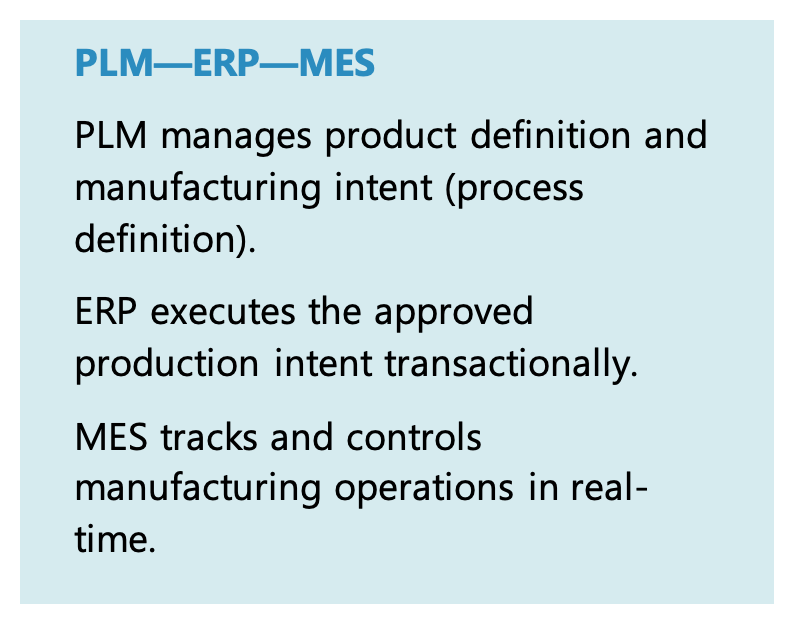 Conversely, ERP executes the business transactions needed to produce the product, serving as the backbone for planning, procurement, manufacturing, logistics, and finance. It also drives the manufacturing execution system (MES) that controls physical production while PLM provides the authoritative product definition, including 3D model-based data.
Neither system is sufficient on its own, as PLM is not ERP, and ERP is not PLM. PLM without ERP and MES leaves business execution fragmented and manual, while ERP and MES without PLM is highly dependent on disorganized upstream inputs. A connected PLM—ERP—MES environment replaces slow, sequential processes with an integrated and concurrent approach to product development and production. This improves execution consistency, reduces engineering-to-manufacturing translation errors, strengthens compliance traceability, and improves inventory resilience. It also reduces reliance on complex ERP customizations and supports flexible, scalable operations.
Ultimately, successful business transformation depends on connecting product definition and execution. Managing product configuration and change in PLM ensures that ERP and MES operate on accurate and approved product data, enabling the correct products to be planned, produced, and delivered.
Figure 1 illustrates how product and process definitions governed by PLM flow into ERP and MES for execution, while operational data is continuously fed back to PLM in a closed-loop digital thread.
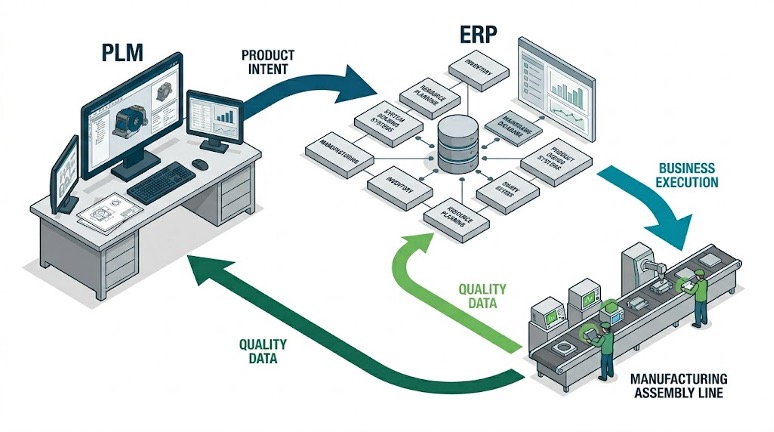
Figure 1: The Complementary Relationships Between PLM, ERP, and MES Enable Concurrent Product Development and a Closed-Loop Digital Thread
Product Characteristics Where PLM Becomes Essential
Product and regulatory complexity in advanced discrete manufacturing verticals, such as aerospace and defense, automotive, electronics, medical devices, and industrial equipment necessitate implementing effective, flexible, and scalable PLM architectures. For discrete manufacturers in these industries, product data is sophisticated and a PLM solution enables holistic systems engineering and advanced capabilities such as Model-Based Systems Engineering (MBSE) and Simulation-Driven Systems Design (SDSD).
 A primary driver of complexity is the rise of highly configurable products. Personalized, scalable, and modular products require strict control and efficient management to ensure conformance, serviceability, and profitability while protecting the bottom line. Additionally, software-defined products require strong multi-domain requirements management, system-level collaboration, and rapid innovation to compete on speed to market compared to their mechanically dominant predecessors. Designing and developing highly configurable software-defined products necessitates deploying a modern model-based PLM environment integrated to a company’s ERP system.
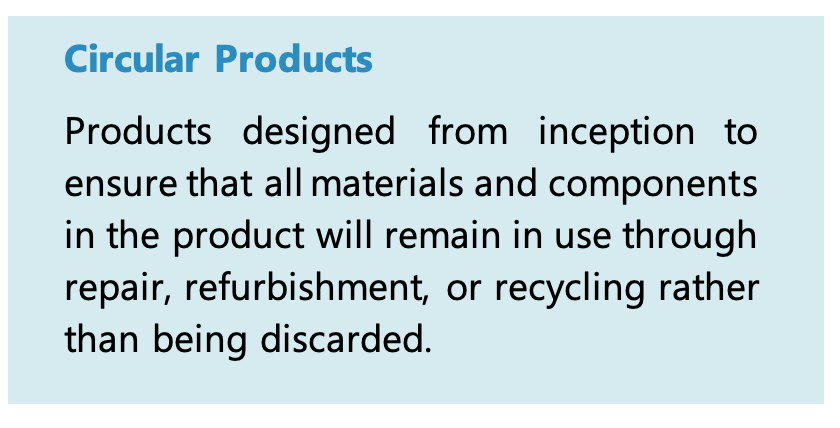
Safety critical or heavily regulated products depend entirely on connected, auditable digital threads for compliance within product lifecycle workflows. Furthermore, durable and circular products must be designed for serviceability to profitably meet modern uptime demands. Circularity starts with repair and material recovery, prioritizing refurbishment, remanufacturing, and recycling; design for circularity requires deep, accurate product data.
High rates of engineering change require closed feedback loops across engineering, manufacturing, and service domains. Effective configuration management down to the serialized asset level, enterprise change impact visibility, and automated change propagation are absolute necessities to prevent schedule slippage, budget escalation, and downstream operational disruption.
Finally, AI, the latest advancement in enterprise software, performs optimally when supplied with reliable, well-organized data like that managed by PLM systems. The commitment to data quality and organization enabled by a modern PLM solution creates substantial benefits for enterprise AI initiatives.
Optimizing the Digital Thread: Multi-BOM Management
The historic single BOM approach is no longer sufficient for managing the intricacies of modern product development and manufacturing processes. Up to date, configuration-aware digital threads, spanning engineering, manufacturing, and service BOMs are best maintained within a closed-loop PLM-ERP-MES and Service environment to properly manage changes, ensuring configuration and data accuracy and completeness. Managing the manufacturing BOM and manufacturing process plan concurrently with the engineering BOM definition within the PLM solution is substantially more efficient than attempting to do so within the ERP system via integration with PLM. And the same concept applies to the service BOM.
When the digital thread is optimized, governed product and process definitions flow directly into ERP via automated release processes. ERP then executes materials requirement planning, procurement, manufacturing execution, and inventory management, while MES controls and monitors physical production. High quality execution data is automatically fed back into the PLM environment closing the product development-manufacturing execution loop. PLM supports long lead-time, risk buy, and strategic sourcing processes giving procurement teams earlier knowledge of upcoming configurations and changes, so supply plans remain resilient as designs evolve. Modern, flexible Software-as-a-Service (SaaS) PLM architectures provide out-of-the-box configurability, speed, scope, and scalability that adapts to the rapid pace of modern product development far better than heavily customized ERP approaches.
Recommendations for Manufacturers
Manufacturers should not force ERP systems to manage upstream product development and evolution. It is critical to define clear system boundaries where PLM completely owns product and process definition, and ERP firmly owns transactional execution. Otherwise, valuable data ends up hidden in personal or local repositories and tools without proper access or configuration control. Each business needs to carefully determine the right balance of PLM and ERP for its unique business model. Organizations should aggressively transition from sequential to concurrent product development by tightly integrating their PLM and ERP environments.
Manufacturers should evaluate dedicated PLM solutions if their products are highly configured, contain software defined elements, are subject to strict regulatory conformance, or are subject to high rates of engineering change. CIMdata highly recommends that companies utilize PLM for complex product definition and BOM transformations, such as from the engineering BOM to the manufacturing BOM. This strategic division of function allows a business to best leverage its ERP investment by enabling ERP to focus purely on its core general ledger, order management, logistics, and inventory functions. Process Plans (operations, routings, work instructions, resources, etc.) should be authored, governed, and change-managed in PLM. ERP consumes these but doesn’t define them. Finally, a direct, closed-loop integration between PLM, ERP, and MES enables model-based product and process data to be consumed at execution time and continuously enriched with quality and performance data from the shop floor, reducing execution variability and non conformance while improving first pass yield and operational performance.
Conclusion
PLM, ERP, and MES systems must complement each other rather than compete. Relying solely on ERP without a foundational PLM environment results in disconnected data, slower processes, and reduced quality as complexities multiply. Connecting product and process definition governed by PLM with business execution driven by the ERP and execution enabled by MES is essential for modern manufacturing performance. Managing complex data structures like manufacturing process plans and BOM configurations within a closed loop PLM—ERP—MES environment enables concurrent product development and ensures consistent, accurate execution across the lifecycle. This approach improves execution predictability and efficiency, reduces downstream disruption, and strengthens end to end traceability across the lifecycle.
As ERP modernization accelerates, the success of these initiatives increasingly depends on the quality and governance of upstream product data. Establishing PLM as the system of record for product and process definition enables organizations to reduce transformation risk, limit customization, and fully realize the value of their ERP and MES investments.
Finally, as companies expand their use of AI, the need for trusted, structured, and contextualized product data becomes critical. PLM provides the foundation and product definition required to enable scalable and reliable AI-driven capabilities across the product lifecycle.