PDF
PDFKey takeaways:
- A high impact PLM program begins with a “real vision” — one tied to the business strategy with measurable goals.
- Effective planning establishes a stepwise progression from measurable goals to an executable roadmap.
- There have been significant advancements in methods and tools by leading PLM solution delivery firms.
- In addition to recently reported planning successes, case studies indicate how it is possible to recover from a poor start.
To achieve real enterprise benefits, a PLM program has to be perceived, planned and executed as a strategic enterprise initiative. The two key elements of any plan are vision and roadmap — defining where the enterprise wants to go and how it will get there. Assuming the prerequisite executive support is in place the challenge is effective planning to establish a vision and roadmap that can deliver strategic impact. First the vision must be relevant and real, meaning it must support the strategic direction of the company, and it must be achievable with measurable goals. Planning must then establish a stepwise progression from measurable goals to executable roadmap. The roadmap must address delivery of business transformation, not just technology implementation.
These concepts have long been recognized by leading PLM practitioners. What is new is the emerging development and application of planning methods and tools by a few leading PLM solution delivery firms. One leading practitioner of note is Tata Consultancy Services (TCS) whose innovation in PLM transformation planning has resulted in recent customer reports of impressive success.
The Vision Must Be Real
The term “real vision” is not a contradiction, but recognition that for a vision to have business impact it must be achievable and must contain goals tied to the strategic objectives of the business. Often a vision statement is well conceived but defined at a high level so that the goals for the program and their linkage to the company’s strategic objectives are not explicitly stated. If that is the case then the goals must be defined explicitly in a companion statement. Further, for the vision to be useful, goals must be converted into measurable performance objectives for core processes of the envisioned future PLM environment.
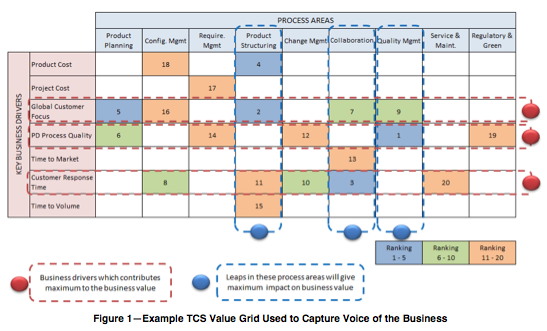
In the TCS methodology business value of a PLM program derives from the intersection of two perspectives. The first perspective is what the business wants to achieve. In other words, what improvement in key business performance measures does the company hope to obtain through implementation of the PLM solution? Definition of these comes from the customers of the PLM program. The second perspective is the potential of PLM solution capabilities for achieving those measures. When these two perspectives are overlaid in a matrix, it is possible to identify, correlate and rank the areas of value that can be delivered by the PLM program. Figure 1 below shows a sample final outcome of such an analysis. The contribution of each PLM process area to each business driver has been measured and ranked.
From Vision To Roadmap
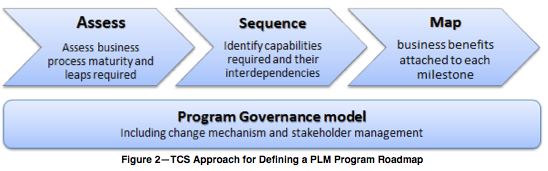
Once the linkage of PLM process areas to enterprise business drivers has been established and the process areas have been ranked according to their potential impact on enterprise vision metrics, then a prioritized implementation roadmap can be developed. In the TCS methodology there are four main steps to roadmap development as shown in Figure 2. The first is to assess the company’s current business process maturity and the magnitude of “leaps” required to achieve the performance objectives. Critical to this step is performing an objective analysis of current and future states. The second step is to identify the PLM capabilities required and their interdependencies. Critical to this step is maintaining alignment with the business model. The third step is to layout the PLM program timeline with milestones and precise articulation of business benefits to be derived in successive phases. Critical to this step is definition of performance metrics that will be used to monitor the progress of the program. The final step is to define a program governance model and change mechanism with accurate identification and assignment of business area stakeholders. Critical to this last step is assurance of key stakeholder involvement and clarity of communication.
Underlying the methods and tools used to execute the four steps are a few key principles that TCS has extracted from practical experience and that they consistently apply when defining a PLM program roadmap:
- Traceability — Any part of the solution and item on the program timeline must have clearly identifiable linkages to a problem or opportunity statement. It should be possible to navigate back and forth and adjust parameters as required to stay on course.
- Tangibility — Maturity assessment output must be usable as input for planning, costing and course correction.
- Transparency — Parameters used for analysis and metrics used for performance tracking must be widely understood and accepted, and performance must be broadly communicated.
- Totality — Definitions for solution elements that are to be implemented along the program timeline must be complete and consistent within the comprehensive scope of the overall program.
- Quantification — Rate of progress and achievement of objectives must be defined and measured quantitatively rather than qualitatively.
- Precision — Messages regarding the program must be conveyed consistently to everyone, everywhere and every time to reduce variations of individual interpretation. This practice reinforces “branding” of the PLM program — enhancing uniformity of perception as to goals and achievements of the program.
Reinvigorating a Stalled Program
Even with executive sponsorship and strategic status a PLM program can stall. Three common causes for a stalled PLM program are:
- Difference in direction from various stakeholder organizations
- Lack of a robust governance model
- Inability to effectively measure progress
All of these shortcomings have their roots in the program planning stage. One of the most common remedial actions for a program stalled by these problems is to concentrate ownership and responsibility for the program within the scope of a single stakeholder, such as the Engineering Vice President. This provides a short-term resolution of the misalignment between stakeholders and their various business goals. However, such narrowing of objectives and ownership undercuts the value potential of the company’s PLM investment. Unless the scope of PLM extends across lifecycle functions for enterprise benefits, the return on investment will be limited.
To reinvigorate a stalled PLM program, it is necessary to recognize the problem for what it is — a false start with its roots in the program planning phase. TCS can attest to the successful remedy of embracing the transformation planning concepts explained in this article, conducting an assessment to identify the weak or missing elements, and then applying appropriate methods and tools to address the gaps.
Conclusion
For companies that are embarking on PLM implementation or expanding current PLM environments, applying PLM Transformation Planning is a key step to success. Today this need is increasingly supported by leading PLM solution delivery firms such as Tata Consultancy Services who are applying and improving PLM transformation planning methods and tools. While CIMdata has been tracking the thought leaders and practitioners in this area for many years, we are now hearing more success stories from customers of firms such as TCS where PLM visions are defined to be wide ranging across the full lifecycle, and documented clearly and concisely in terms of measurable objectives. These quantifiable enterprise visions are related to PLM process areas, providing quantitative ranking of the planned PLM solution elements, which are then prioritized in placement along a program roadmap timeline. It is encouraging to see so much activity and progress in this critical area.