PDF
PDFAutodesk Analyst Day 2011
Autodesk held their 2011 Analyst Day at the Artists for Humanity (AFH) facility in South Boston on October 20. Nearly thirty analysts were invited to hear a company update by Autodesk executives. The setting was appropriate, as the AFH, the first LEED Platinum Certified building in Boston, was designed using Autodesk solutions.
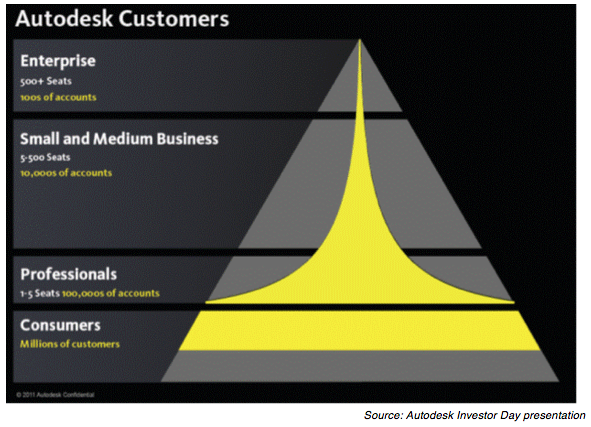
Leading off the day was Autodesk’s CEO Carl Bass, who spoke about “Autodesk Today and Tomorrow.” Some of his talk echoed their Investor Day presentation in June. Mr. Bass presented a chart depicting Autodesk’s customers by company size. Enterprise customers are at the tip of a very steep spike, but they are Autodesk’s fastest growing segment, now making up 30 percent of revenues.
Even with their financial success and increasing work with large customers, Bass said that for years Autodesk has struggled to be known as more than the “AutoCAD company.” But Mr. Bass claims that he has now succeeded, having recently been introduced as the head of the “AutoCAD and SketchBook” company. (Autodesk recently passed 7.5 million downloads of SketchBook Mobile, a product created on the sly over some internal objections, including Mr. Bass’.) Jokes aside, Autodesk has greatly expanded their portfolio, both organically and through acquisition. Mr. Bass stated that he would readily match his portfolio against anyone’s in the industry.
He also made mention of his anti-PLM rap, well-known on YouTube. At the Boston session, Bass updated his remarks from the video. He claimed that the largest PLM solution suppliers are making PLM a problem not only for themselves but for many of their customers as well.
Perhaps what Autodesk announced after the Investor Day session on their “Everything Changes 11.29.11” web site [http://tinyurl.com/6z5mp2t] may address the PLM problem. On November 29, “Autodesk will forever improve the way you manage your business processes and workflows when we unveil a modern, zero-deployment solution that makes collaboration, data, and lifecycle management accessible to anyone, anytime, anywhere.” We’ll all have to wait until Autodesk University (AU) to hear the details.
Autodesk has done a lot of organic work on different ways to leverage the cloud, as we highlighted at the CIMdata Vendor Forum last March. The Autodesk Labs site includes a number of projects; for example Project Photofly, which requires about twenty photos to get a 3D model from the cloud, with accuracy within hundredths of an inch.
One way to leverage the cloud is to bring many computers to bear to solve a single problem. Mr. Bass used an interesting chart to illustrate “infinite computing”:
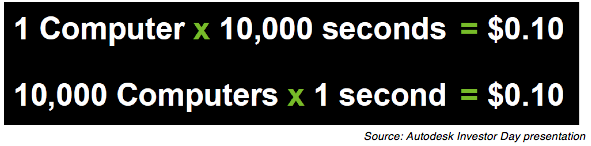
It used to be that we would buy (or lease) a computer to provide one user that 10,000 seconds. Now you can tap 10,000 computers to solve your simulation and analysis problems. Autodesk plans offerings that exploit the cloud and infinite computing, such as photorealistic rendering (Project Neon) and “always on” simulation that gives real-time feedback to a product designer.
Scott Reese, Senior Director of Simulation, expanded on this theme. He noted that Autodesk has spent more than $500 million on simulation technology in the past few years. Autodesk has a commitment to multi-CAD for their simulation tools, and to multi-CAE for their design tools. This will not change. Autodesk Fusion, a direct modeling CAD tool, is now included with all simulation suites.
Autodesk will also continue to support traditional simulation (CAE) customers by integrating CAE offerings to allow multi-physics simulations, and by integrating geometry (CAD) capability with their simulation offerings.
Mr. Reese then described a vision to remove the barriers to simulation: ease of use, IT hardware and infrastructure requirements, and total cost. Autodesk is investing in unified simulation that provides continuous feedback during product design. For example, Project Krypton provides information on manufacturability, cost, and environmental concerns for molded parts. The goal of such unified simulation tools is to give design guidance, not to replace end-of-design simulation for verification.
To reduce IT infrastructure needs, Autodesk offers cloud-based optimization for Inventor. Also, Project Storm demonstrates a cloud computing tool for structural analysis of a Revit Structure analytical model. Moldflow Insight WS (Web Services) offloads Moldflow Optimization studies to the cloud, freeing local resources.
Autodesk likens their web and cloud offerings to having a gym membership rather than owning home exercise equipment. They contend that customers want access, not ownership. Prepaid “cloud units” will give access to the full range of offerings without the need for specific licenses. This will reduce the hassle (if not the price) of entry for customers to evaluate new capabilities.
Previous attempts to democratize simulation and make it accessible to non-experts and smaller companies have, in CIMdata’s view, not been very successful. They have tried to simplify tools and hide details of the simulation process from the end user. In CIMdata’s opinion, the resulting tools were error-prone and inflexible. Autodesk’s vision is interesting because it does not impose the experts’ processes on non-experts. Rather, according to Scott Reese, it provides guidance to designers where none was available before. It reduces the need for full-blown simulation studies during product design, though it does not replace the need for proper design validation.
Conclusion
Over the last decade, Autodesk has moved beyond their AutoCAD roots to become a leading broad-based software company with a significant PLM-related solution offering. Their $500+ million investment in simulation and analysis (S&A) makes them a leading player in that space. Autodesk’s plan to use the cloud to bring their offerings to their broad range of customers is a new twist on the “democratization” theme. Other S&A players are leveraging the cloud, but Autodesk’s approach is interesting. We’ll see if this is part of the “everything” that will change, on November 29 at Autodesk University.