PDF
PDFFood and beverage industry customers demand a continually expanding variety of healthy, high quality products at continuously lower prices. At the same time, food and beverage companies want to expand their markets and sell the same or similar formulas and products in multiple geographic regions. This requires understanding the local culture, tastes, available raw materials and ingredients, and importantly, local regulatory requirements. Perhaps the most difficult issues to address are those related to regulations. Regulatory requirements vary by region and by product and are becoming increasingly complex and difficult to support. Each region and/or product normally requires different packaging, labeling, and reporting.
As discussed in the CIMdata white paper, Delivering PLM Technology to Solve Food & Beverage Industry Issues: Infor Optiva, published in May 2012, regulatory issues primarily fall into two categories: food safety, where the product may be physically harmful; and labeling, for which completeness and accuracy are extremely important. As labeling requirements have increased, the number of labeling issues has increased dramatically. The costs related to labeling errors are high because they result in product recalls after investment funding has already been spent on development, production, distribution, advertising, and promotion. While in many cases labeling may not cause safety issues, mislabeling allergens like peanut contamination can be serious and even fatal. Regardless of the cause, if there are label errors, the product must be removed from store shelves and cannot be sold. A common scenario is that an organic (or other claim–related) ingredient is inadvertently replaced in a formula with a non–organic counterpart and the replacement is not identified until the product reaches the grocers’ shelves. The product must be pulled, returned, and most likely destroyed.
The label on a modern food or beverage product is complicated, containing a significant amount of information that is owned by different organizational groups (including Research and Development, Regulatory, and Marketing) that must be fully and accurately reported. Management and coordination of this information is complex, data intensive, and usually done electronically in an ad hoc way using manual processes and tools such as Microsoft Word and Excel, email, and Photoshop. Using a mixed set of tools and manual processes introduces errors and invalidates the accuracy of the label. Additional manual processes increase the time needed to define, validate, and obtain approvals for a label, which delays the product’s introduction into the market.
Given the complexity of a label, it is critical that the labeling solution used by a food and beverage company be able to completely and accurately generate, validate, and format the label as required for each variant of every product, regardless of where it will be sold and what regulatory and compliance reporting requirements are applicable. By using a consistent, integrated tool set, food and beverage companies can accelerate the time to define, validate, and approve their labels and ensure compliance with all applicable labeling requirements, regardless of the geographic region or country.
A typical label has multiple types of information created and managed by multiple organizations and sources including research and development, marketing and sales, and regulatory compliance. Information on a label includes ingredient and nutrition data, allergen and safety information, and marketing material (e.g., size, type, etc). This data must be complete and accurate, and comply with all local regulatory requirements. Further, it must be appealing to the local consumer and provide them the information they need to decide which product to purchase. Thus, it must be presented in the appropriate language with artwork designed for that product and geographic region.
Labeling within the food and beverage industry consists of three main concepts: the ingredient list, the nutritional fact panel, and claims. Claims are statements on the label such as “low fat” or “heart healthy” that are based on recipe data. If a recipe has fat content below a threshold the product can claim to be “low fat.” Other common claims might include whether a product is compliant with Kosher or Halal requirements. Other content that may be required is a warning flag, e.g., “This product was produced in a plant that also processes products made from peanuts.” Best–in–class food and beverage PLM solutions generate labels automatically from the ingredient and recipe data stored within the solution, but allow manual tailoring of the labels to meet market reporting requirements. Each of these areas contains information that must be updated whenever a recipe, claim, or nutritional item is altered or replaced. To be effective a labeling solution must be linked to multiple sources and automatically update the appropriate label content whenever any applicable item is changed.
Infor Optiva Global Labeling Capabilities
Infor Optiva’s global labeling module provides complete control of content and how the label is output. The list of ingredients is extracted from the formula, and the label data can be tailored to the local product requirements including content, layout, and language. A single recipe can be packaged and labeled for multiple markets in multiple languages from centralized or distributed production plants. When a change to the recipe is implemented all affected labels are identified, and can be updated quickly and under proper change management control.
The depth of Infor’s commitment to the food and beverage industry is shown by functionality in controlling the label output. For example, when an ingredient list is created, the ingredient order, a header, footer, and the ingredient name can all be controlled. In addition, how reconstituted ingredients are displayed can also be controlled. For example, does the label show milk, or powdered milk and water? Finally, ingredients that are below a reporting threshold don’t have to be displayed. The nutritional fact panel values are derived from calculations based on the product’s formula. They can be validated at any time from the formula and the output can be used to create the nutritional fact panel on the label. If product testing shows value variation, the label can be adjusted, with proper approval, to ensure compliance. Both the ingredients list and the nutritional fact panel data can be linked to the artwork files managed within the Infor Optiva database. This enables label content to be driven and controlled directly from the formula.
The following figure presents an example of Infor Optiva’s user interface showing fields for inputting label information.
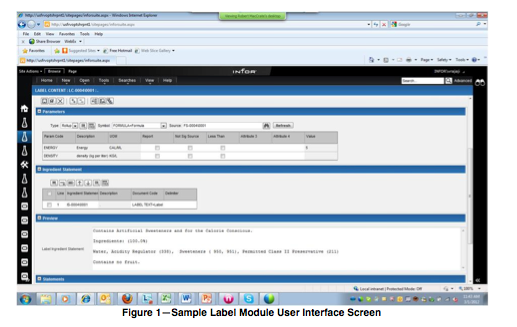
The Infor Optiva global labeling module’s integration with formulation, artwork, compliance, and language functions within the Infor product suites ensures that a company can be confident that its labels are compliant, complete, and tailored to their global needs.
Summary
Proper labeling is critical to success in the food and beverage industry. It must provide the information that consumers need to make informed decisions about the foods and beverages they select; it must meet all regulatory requirements; and it must be maintained accurately and kept up–to–date whenever any change is made to the formula, claims, or nutritional content.
Infor Optiva provides the capabilities food and beverage, home and personal care, pharmaceutical, and nutraceutical companies need to design and produce labels that consistently meet government regulations. Since the labels are generated directly from the single source of truth data store in the PLM system, the risk of labeling error is greatly reduced. Demonstrating this is the fact that between 2009 and 2011 there were 1,669 FDA recalls, and in 2011 the USDA had 103 recalls affecting 40 million pounds of food; but no product produced using Infor Optiva was recalled for labeling–related errors.