How Autodesk Fusion and Fusion Manage help SMBs scale without creating enterprise PLM complexity
Takeaways
- Small- to medium-sized businesses (SMBs) face many of the same competitive pressures as large enterprises but with significantly fewer engineering, IT, and administrative resources; more constrained budgets; and no tolerance for long deployments typically required for traditional enterprise PLM.
- Disconnected data and processes result in multiple issues, including measurable increases in costs, missed profitability targets, late launches, and expensive late-stage changes, that early cross-functional collaboration could prevent.
- Connected product development establishes a common product definition that improves collaboration across engineering, manufacturing, procurement, suppliers, and quality while providing a scalable foundation for future business growth.
- Modern configurable cloud technologies have significantly reduced the cost, complexity, and deployment effort traditionally associated with PLM.
- SMBs need to prioritize the evaluation of product development platforms based on ease of use, ease of deployment, time-to-value, integration in their processes and with other digitalization solutions, configurability, scalability, and total cost of ownership.
- Autodesk combines Fusion and Fusion Manage to provide an integrated cloud platform that connects engineering design, product data, lifecycle management, and business processes for growing SMBs.
- A connected data foundation positions SMBs to leverage AI-driven capabilities as they mature.
Introduction: Business Challenges Facing SMBs
Small- and mid-sized manufacturers operate under the same market pressures as their larger competitors—accelerating product complexity, shorter development cycles, rising customer expectations, and global supply chains, but with a fraction of the engineering, IT, and administrative resources.[1] The same team members are responsible for designing products who are often simultaneously managing supplier relationships, resolving manufacturing issues, and responding to customer requests. There is no organizational slack, no dedicated PLM center of excellence, no large IT staff to support complex PLM software, and no appetite for systems that demand months of implementation before delivering any value.
SMB companies’ products are becoming more complex. Mechanical, electrical, electronic, software, and connected content increasingly coexist within single products across all industries. Managing that complexity through disconnected engineering applications, spreadsheets, shared network drives, email threads, and tribal knowledge is a strategy that ultimately fails. The tipping point appears when growth itself—more people, more products, and more partners overwhelms the informal systems that once seemed adequate.
Why Traditional PLM Has Not Been the Answer
Enterprise PLM solution implementations typically assume dedicated administrators, large IT departments, formal change control organizations, and implementation budgets that most SMBs will never have. The systems were designed for a different organizational model—one in which PLM is a dedicated discipline, not a shared responsibility. SMBs do not reject PLM because they do not need it. They reject it because the systems available were not designed for how they work.
Long deployments, high licensing costs, and complex configuration requirements have made traditional PLM a non-starter for most SMBs. Organizations that have attempted traditional PLM implementations without the supporting infrastructure frequently fail to achieve meaningful adoption—and can find themselves worse off than before, having invested significant time and money without realizing the expected benefits.
The Hidden Cost of Doing Nothing
Operating without connected product data and structured processes is not a neutral choice—it carries a measurable and growing cost. When engineering operates in isolation from manufacturing, quality, sourcing, and the supply chain, decisions made early in the product lifecycle routinely generate late-stage problems at the point where they are most expensive to address. Industry data consistently shows that a significant majority of new products miss their cost targets, miss their launch dates, and require costly late-stage changes that earlier cross-functional involvement would have prevented.
Change management and supplier collaboration coordinated through email create audit gaps, missed approvals, and repeated mistakes. Trying to manage BOMs in spreadsheets and through shared files generates version conflicts and manufacturing errors. Release processes managed informally result in products moving to production before they are ready, driving scrap, rework, warranty claims, and customer dissatisfaction. As organizations grow, the compounding effect of these process gaps accelerates—informal systems that functioned across a group of ten people cannot support the volume of products, people, and partners that a growing business demands. The cumulative impact is not just operational. It erodes the margins, competitiveness, and growth potential that SMBs cannot afford to sacrifice.
Product Development Best Practices for SMBs
The answer for SMBs is not a scaled-down version of enterprise PLM. It is a fundamentally different approach to connected product development—one that delivers the outcomes PLM promises through modern cloud technologies that match the operational realities of growing manufacturers.
PLM Outcomes Without PLM Complexity
What SMBs need is not the governance architecture of enterprise PLM—they need version control, change visibility, cross-team alignment, and traceability, delivered in a form that is fast to deploy, easy to use, easy to administer, scalable without disruption, and priced for SMB budgets. BOM management, change management, and release management represent the highest-priority starting points: the capabilities most directly responsible for product quality, launch timing, and cost that provide immediate, measurable value from day one.
A Common Product Definition Across the Enterprise
Connected product development begins with a single, authoritative, trusted product definition accessible to everyone who needs it—engineering, manufacturing, procurement, quality, documenters, suppliers, and others. When all stakeholders work from the same current product information, version conflicts and miscommunication are eliminated at their source. Updates propagate naturally to the people and systems that depend on them, and the cost of late-stage surprises drops significantly because the information needed to catch problems is available early in the lifecycle.
Early Cross-Functional Collaboration
Best-practice manufacturers do not design products in engineering and then hand them off to manufacturing, quality, and supply chain to discover problems. They connect those functions upstream—incorporating manufacturing constraints, quality requirements, supply chain realities, and service needs into product development processes while they can be used to influence the design. This approach reduces launch delays, product cost, scrap, rework, and warranty exposure, and improves after-sales product support. SMBs need access to the same cross-functional collaboration capability without requiring the organizational scale it has traditionally assumed.
Evaluating PLM Platforms on the Right Criteria
Feature-by-feature software comparisons is the wrong focus for SMB PLM evaluation. The questions that matter for SMBs are operational: How quickly can teams realize value? How much IT expertise is required to deploy and administer the software? How well does it integrate with existing design tools and business systems? How easily can it be configured to match existing processes? How does it scale as the business grows? And what is the true total cost of ownership—including implementation, administration, training, and upgrade costs—not just the license price? A platform that cannot be deployed quickly, administered without dedicated IT expertise, or scaled without re-implementation is not a viable long-term investment for an SMB.
A Foundation for Future Growth and AI
The connected product data environment that delivers immediate operational value today is also the foundation for the AI-driven capabilities that will define competitive advantage tomorrow. Predictive quality, automated change impact analysis, intelligent supply chain decisions, and AI-assisted design all depend on clean, connected, traceable product data. SMBs that establish that foundation now—through integrated cloud PLM—position themselves to leverage these capabilities as they mature, without the cost and disruption of re-platforming when they are ready to adopt them.
Autodesk Fusion Industry Cloud for Manufacturing
The Fusion industry cloud for manufacturing connects capabilities, data, people, and processes across the entire product development lifecycle. This includes CAD, CAM, CAE, PCB, data management (PLM, PDM), MES, enabling advanced automation, AI capabilities, and streamlining of workflows.
The Fusion industry cloud provides a single source of project data across an organization and supply chain through the Autodesk data model. By ensuring everyone has access to the same data, you can eliminate repetitive tasks and processes, accelerate productivity, and supply critical real-time insights about product development and business operations.
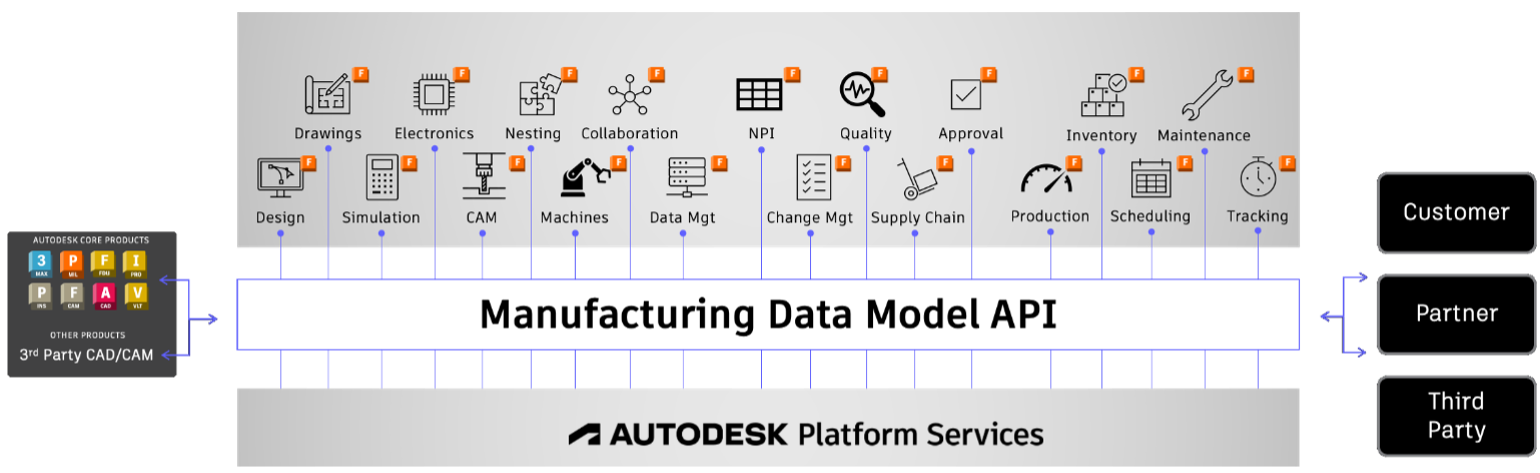
Fusion Industry Cloud—An Integrated Platform Connecting Design, Manufacturing PLM, and Enterprise Systems
(Courtesy of Autodesk)
Autodesk Fusion: Design and Manufacturing in a Single Cloud Environment
Autodesk Fusion brings CAD, CAM, simulation, electronics, and manufacturing together in a single cloud environment, eliminating the file translation, version management, and manual coordination that occur when design and manufacturing tools operate independently. Version control, access control, engineering BOM management, concurrency management, and process automation are built directly into the workflows that product development teams already use, rather than layered on top of them as separate administrative functions.
Because Fusion is cloud-native, product data stays current and accessible from anywhere—enabling teams to collaborate across sites and time zones, giving suppliers and contract manufacturers the controlled visibility into the information they need, and ensuring that the design environment and the data environment are never out of sync.
Fusion Manage: Cloud PLM Built for SMB Scale
Fusion Manage is the PLM layer of the Autodesk platform, providing item management, BOM management, change management, release management, quality management, supply chain collaboration, new product introduction, and requirements management through an out-of-the-box library of configurable process workspaces. It requires no on-premises infrastructure, no custom coding, and no lengthy implementation engagement. This directly addresses the constraints that have historically made PLM inaccessible to SMBs.
The template library covers the full range of processes SMBs need most—change and deviation management, quality management, FMEA analysis, supplier collaboration and corrective action, new product introduction, document control, and more. This enables rapid deployment without custom development. Configuration requires no coding, and role-based interfaces with granular permission controls ensure that internal teams, suppliers, customers, and contract manufacturers access only the information appropriate to their role.
Tiered subscriptions—enterprise subscriptions to Fusion and Fusion Manage Enterprise allow organizations to align their initial investment with current needs and expand capability as requirements grow, without platform changes or re-implementation.
Integration Changes the Equation
The integration between Fusion and Fusion Manage is the advance that changes what is possible for SMBs. Engineering data created and managed in Fusion flows directly into Fusion Manage, where it connects to downstream business processes—change management, quality, supply chain collaboration, and operations—through a single cloud platform. When a design changes in Fusion, the impact propagates automatically: change requests are initiated in context, BOMs update in real time, and release processes reflect the current state of the design without manual reconciliation or data re-entry.
This eliminates the manual handoffs, data translations, and version conflicts that occur when engineering and enterprise systems operate independently and completes the enterprise data loop by connecting to ERP systems for item masters, manufacturing BOMs, purchasing, and logistics. For SMBs, this means that the cross-functional alignment that best-practice manufacturers use to reduce time to market and product cost is now achievable through a platform they can deploy quickly and manage without dedicated IT resources.
Time to Value
Cloud-native deployment means SMBs can realize value from Fusion and Fusion Manage quickly, without IT infrastructure procurement or complex configuration projects. The Fusion for Design bundle provides an accessible and cost-effective entry point for teams ready to move from informal data management to integrated product development supported by PLM. Autodesk's partner network provides implementation services scaled to SMB needs and budgets, using a phased approach that moves organizations from initial deployment through self-sufficiency. This builds internal capability progressively rather than creating ongoing dependency on external expertise.
Customer Evidence
Autodesk reports measurable results across a range of SMB manufacturers that have adopted Fusion and Fusion Manage:
ME Global reduced engineering release time by up to 49% within the first five months of deployment—demonstrating the immediate process impact that integrated cloud PLM can deliver even in early stages of adoption.
Pressure Products realized over $300,000 in measurable operational savings from quality management alone in the first three years, with returns continuing to grow as Fusion Manage scaled with their operations.
Woodway USA reduced pre-shipment errors and issues by connecting departments and vendors through a single data environment, enabling more products to reach customers on time and with fewer defects.
Native Instruments compressed accurate product cost calculations from more than a week to minutes through connected supply chain and cost data in Fusion Manage—enabling faster and smarter business decisions.
Aclara eliminated on-premises hardware maintenance and reduced the cost and time associated with system upgrades by moving to cloud PLM, realizing both operational savings and continuous platform improvements without implementation overhead.
Conclusion
Growing manufacturers have historically faced an uncomfortable choice: accept the limitations and hidden costs of informal product development processes or attempt enterprise PLM implementations that their organizations are not resourced to sustain. Neither choice is a good one.
SMBs compete with large enterprises every day while operating with significantly fewer resources and the product development platforms available to them should reflect that reality. The measurable cost of disconnected data and informal processes—missed cost targets, late launches, expensive late-stage changes, scrap, rework, and warranty exposure is a cost that connected product development can significantly reduce. Modern cloud technologies have removed the barriers of cost, complexity, and deployment effort that once made PLM inaccessible, and a common product definition that connects engineering, manufacturing, procurement, quality, and suppliers is now achievable at SMB scale.
Evaluating product development platforms based on the right criteria—ease of use, ease of deployment, time-to-value, integration, configurability, scalability, and total cost of ownership leads to a different set of conclusions than feature comparisons alone. Autodesk's combination of Fusion and Fusion Manage represents a meaningful answer to this challenge: an integrated cloud platform that connects engineering design, product data, lifecycle management, and business processes in a way that growing manufacturers can realistically deploy, administer, and sustain. And the connected data foundation that delivers immediate operational value today is the same foundation that will enable AI-driven capabilities—predictive quality, automated impact analysis, intelligent supply chain decisions—as they mature.
CIMdata recommends that small- and mid-size manufacturers evaluating their approach to product data and process management take a look at Autodesk Fusion and Fusion Manage as a practical, scalable path to connected product development that is built for the realities of SMB manufacturing.