PDF
PDFContinuous pressures to improve productivity, lower costs, compress delivery times, and enhance product quality are challenging manufacturers around the world. At the same time, the quest for innovation of both products and internal processes is essential for companies to be successful. In this environment, companies are investing in numerous initiatives that promise to address these challenges.
One of the key factors in delivering right-to-market products in the shortest possible time is improving how companies analyze, simulate, and test new designs and create physical products to validate that the design (i.e., the virtual product) meets the functional requirements and all applicable standards. Historically, this was accomplished using a combination of various stand-alone analysis tools and the construction of physical prototypes to test. Such processes typically added significant time and cost to the overall development process. Additionally, if the analysis and simulation of the virtual model were not considered to accurately reflect the physical product, designers would usually “over-engineer” the product to ensure it would not fail once in use. This practice usually introduced additional materials, weight, and cost into the design. Furthermore, engineers did not have the time to explore multiple alternatives, which could lead to locking in suboptimal designs driven by program timing and budget constraints.
To address these issues, engineering Simulation and Analysis (S&A) tools have increasingly become an indispensable component of the product development process. Technologies such as structural analysis, multi-body simulation, and computational fluid dynamics let engineers quickly and cost-effectively investigate “what-if” scenarios, explore new ideas, evaluate alternatives, and gain deeper insight into how a product will behave during use. In this way, S&A tools have become powerful enablers for developing innovative products as well as establishing and enabling innovative design processes.
Real value derives from analyzing products earlier in the product development lifecycle. Embedding analysis within the normal design environment (CAD) enhances the value of using analysis, allowing it to be used throughout the product definition lifecycle to guide decision-making and product validation. Ways in which companies can benefit by using S&A early and frequently in their product development process include:
- Support Faster Design—Early simulation and evaluation of design decisions speeds up the design process and allows evaluation of more alternatives.
- Improve Product Design—Designers and engineers can have a more complete and better understanding of design issues so they can make better design trade-off decisions earlier.
- Avoid Rework—Using analysis to validate designs helps avoid design errors that can result in costly rework.
- Improve Quality—Designers can try more iterations earlier, which can lead to better, higher-quality products that exceed customer expectations.
- Reduce Prototypes—Using analysis to better understand designs can decrease the need for producing physical prototypes and running expensive physical tests.
In many companies, S&A is handled in a serial manner in which conceptual engineering creates a design and then passes it to simulation specialists who then enter (or most likely re-enter) the design data in a form needed to run their simulation applications. Once complete, they return the results of the S&A to conceptual engineering who then update the design. This process is repeated until the design meets all requirements. Unfortunately, this process is time consuming, and while the simulation specialists perform their analyses, the conceptual designers often continue to work—which results in designs developed (or modified) without the needed simulation and analysis being performed to determine what changes should be made. In addition, sometimes the analysts with the greatest insight into the simulation results have the least insight into design constraints and therefore may not perform the most optimum analyses for a specific design.
A major change that is occurring in product development is the transition of S&A from being performed by highly trained specialists to an environment where designers and engineers can perform S&A as part of their normal tasks. A theme of product development is the incorporation of “simulation-driven design,” reflecting the evolution to virtual simulation environments that encompass both the physical aspects of the product as well as the end-users’ experience using the product. As a result, designers and engineers are able to more quickly incorporate feedback from simulation results, and S&A experts are freed to work on more complex and difficult problems.
Detailed analysis and multi-physics/multi-discipline capabilities continue to be enhanced, but these capabilities will provide even more value as they are made available more broadly through “packaged” services that capture best practices so that they can be used by non-experts, especially early in the product development process. S&A will become a fundamental part of the conceptual design process, not a validation phase that occurs after a significant level of design is completed.
As product complexity continues to grow, the computational resources required to conduct better, more complete S&A is increasing. More and more computing power is needed to perform comprehensive multi-physics and higher degree of freedom analyses, as well as to conduct effective design optimization. However, the desktops and workstations used by most designers and engineers do not have the required computational power. Performing simulations consumes their resources and prevents them from performing other work. To address this situation, new approaches are needed and are being developed. Cloud-based solutions can be deployed as a means to process multiple S&A jobs in parallel and, potentially as important, they can be used to apply significantly more powerful computing resources that would be unavailable at a local user or company level. For example, rather than have engineers spend their valuable time simplifying geometry prior to analysis, the massive compute power available across the Cloud in high performance computing (HPC) centers could be used to perform multiple complex pre-processing and then run additional analyses.
The advent of Cloud computing with high performance networks and access to remote HPCs is providing new solutions to this problem. One company that is creating these new solutions is Autodesk. As part of their initiatives for the use of Cloud and remote/distributed computing, Autodesk is developing new ways to deliver simulation and analysis via the Cloud and HPCs.
Autodesk’s Cloud-based S&A programs include Project Cumulus and Inventor Optimization. For these programs, Autodesk is building into their products (e.g., Inventor) the ability for designers and engineers to automatically launch simulations and perform analyses and design optimization using HPC facilities in the Cloud. They are simplifying the actions a user must perform to execute an analysis and get the results. Figure 1 illustrates how Autodesk is delivering these new capabilities.
In this example the user does a onetime login to access the Cloud. After that, he or she simply requests that a simulation be performed. Autodesk’s software automatically acquires all the appropriate geometry and simulation inputs (boundary conditions, limits, etc.) and then transfers that information across the Cloud to the pre-defined HPC. That HPC may be a public site or a private site. The software at the HPC then performs the meshing, executes the necessary solvers, runs the appropriate post processor, and then returns the results to the user.
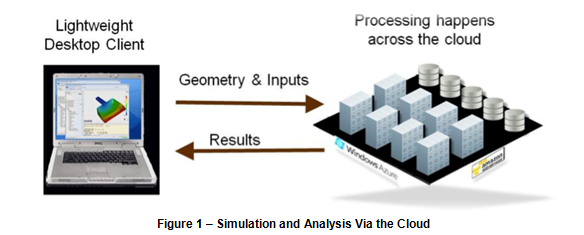
While the simulation is being executed, the user’s local computing system is available to perform other tasks. There are many benefits of this type of solution:
- The user continues to be productive on his or her local system.
- The user does not have to spend time preparing the analysis for execution.
- The HPC can apply multiple techniques to process the simulation:
- Use multiple processors,
- Apply a Grid solution.
- The user gets the results much faster and can make better design decisions.
- It enables users to try more design alternatives and to better optimize the design.
- With the appropriate inputs, design optimization can also be conducted automatically.
- Multiple users can access the HPC simultaneously.
- It reduces the cost for acquisition and support of high performance systems by the company—making HPC available to all sizes of companies.
By taking advantage of the Cloud and making HPC available to more designers and engineers, Autodesk is helping its clients be more productive and better able to develop and deliver competitive products.
CIMdata believes that intelligent use of the Cloud and Cloud-based computing resources will help companies in all industries to be able to better develop innovative products. Autodesk is an example of how using the Cloud can make more powerful and comprehensive simulation and analysis more readily available and easier to use for broad new classes of users in companies of all sizes throughout the product development process.