Oracle: Unleashing Agentic Applications Across the Enterprise
Takeaways
- A Shift to Outcome-Driven Execution: Oracle is redefining enterprise software by shifting the focus from systems of record to systems of outcomes.
- Breaking Down Organizational Silos: Oracle is leveraging foundational transactional data across its enterprise footprint; domain-specific artificial intelligence agents effectively remove traditional organizational walls.
- Growing AI Ecosystem: Oracle reports that more than 7,000 customers have deployed its basic generative AI services. It has delivered over 1,000 AI agents through Fusion Applications and says more than 80,000 certified experts have trained in Oracle AI Agent Studio. Oracle offers AI Agent Studio to Fusion Applications customers at no additional cost.
- Targeted Agentic AI in PLM: The Oracle supply chain and product lifecycle management portfolio now features specific agentic applications designed to reduce cognitive load and orchestrate engineering workflows.
Over the last several months, CIMdata has had the opportunity to attend an Oracle Analyst Meeting held on April 28, 2026, at the Oracle Park in San Francisco, California,[1] as well as quarterly Oracle Fusion Applications updates. Oracle communicated to the market a strategic pivot for their enterprise software portfolio. The overarching theme is centered on the concept of moving from systems of record, which merely document business transactions, to systems of outcomes that actively help run the business. Oracle executives demonstrated how they are embedding artificial intelligence into the core of their Fusion Applications to help users work toward specific objectives, solve complex problems, and autonomously execute tasks.
Redefining Enterprise Software: Systems of Outcomes
Historically, enterprise software has required humans to perform tasks, make decisions, and record the resulting actions within a system. Over the last several months Oracle has introduced a new software paradigm by initially announcing 22 new Fusion Agentic Applications in March 2026 followed by an announcement in September 2026 which raised the total number of agentic applications to 75. At Oracle’s April 2026 Analyst Meeting, Executive Vice President of Applications Development, Mr. Chris Leone, explained that artificial intelligence (AI) can now move beyond participating in work to actively leading it. These agentic applications are built for enterprise execution and are driven by specific business outcomes, as illustrated in Figure 1. They utilize dynamic workflows that adjust to changing conditions.
Instead of a single AI model handling an entire process, Oracle utilizes teams of specialized agents that continuously share context and memory across end-to-end processes. This approach breaks down traditional organizational silos, allowing domain-specific agents to interface with data across product lifecycle management (PLM), supply chain management (SCM), enterprise resource planning (ERP), and human capital management (HCM). CIMdata has long held the belief that successful enterprise solutions break down process, data, and organizational silos. With the availability of AI agents, there is now hope that this can be fully realized. Oracle’s solution is designed to handle cognitive loads that typically burden human workers, freeing employees to focus on more challenging and strategic issues. More importantly, all execution by these agents remains fully auditable and governed by enterprise security policies, a key principle espoused by CIMdata for the effective adoption of AI by organizations.
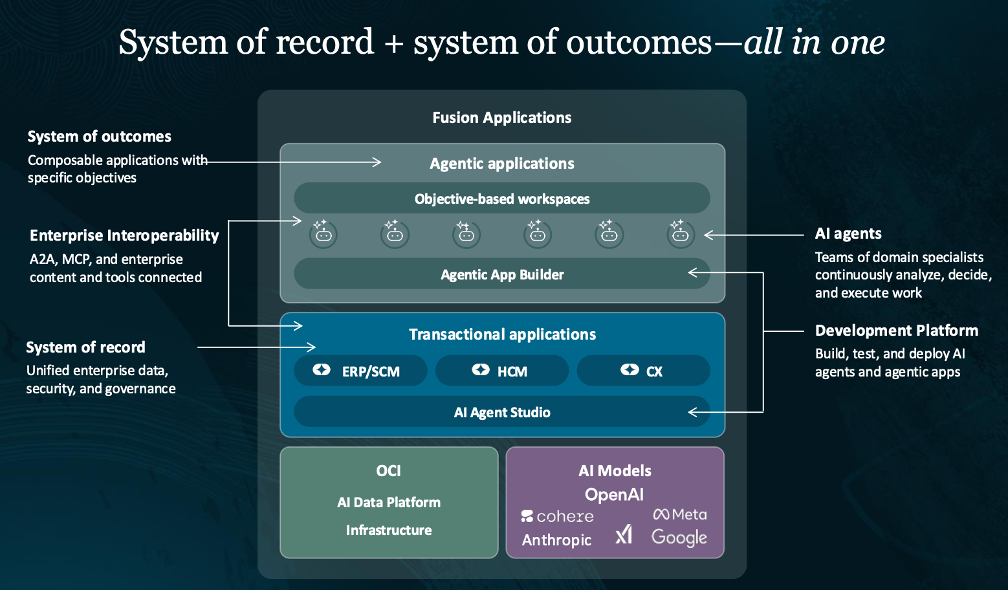
Figure 1—Oracle’s Architecture Combining Systems of Record with Systems of Outcomes via Agentic Applications
(Courtesy of Oracle)
Building the Ecosystem: Studio, Marketplace & Pricing
Oracle’s architecture approach, which combines systems of record with systems of outcomes via Agentic Applications, appears to be well received by the market along with its potential business value as illustrated by the rapid growth and expansion of its AI ecosystem. Oracle reports impressive adoption metrics, including over 80,000 issued AI Oracle AI Agent Studio expert certifications, and 7,000 deployed customers. The ecosystem is supported by 250 marketplace partners who have helped deliver function and domain-specific agents. Such a dramatic growth of the Oracle AI ecosystem is impressive and provides market validation of its business value and adoption. Additionally, Fusion AI Agent Marketplace, announced late last year, allows customers to easily discover and instantly deploy partner-built Oracle-certified and maintained agents from within the Oracle AI Agent Studio.
For development, Oracle’s AI Agent Studio provides a continuum of tools from no-code environments, which use a visual agentic canvas to define workflows in natural language, to pro-code environments supported by Codex[2] for generating production-ready code. Recognizing that cost predictability is a major concern for enterprise software customers. Oracle has introduced a pricing model built around business outcomes rather than metering every unit of compute. Customers can buy it two ways: a flat per-seat subscription, or usage-based consumption measured in AI Units. Standard agent work (‘general’ action types) running on Oracle’s OCI-hosted basic model, which today is GPT-oss, carries no per-action draw, so routine usage stays predictable at a flat rate. Each account includes 30,000 AI Units a month, letting customers test and roll out capabilities with limited financial exposure. Premium LLMs are available for teams that want them and consume AI Units as they’re used. Oracle’s AI Agent Studio lets business users and developers alike build agents that address real operational needs without heavy cost. This approach gives customers flexibility along with more predictable AI spend.
The Next Generation of PLM: AI-Driven Agentic Apps
During CIMdata’s numerous interactions with Oracle’s PLM leaders the past eight months, Oracle has detailed how these agentic capabilities apply directly to product development and engineering and explained how agentic applications are being developed to consider enterprise change impacts across product, manufacturing, and supply chain domains. Within the Oracle Fusion Cloud solution PLM AI agents natively work across the range of Fusion applications and data sources allowing users to leverage AI agents and enabled workflows that focus on business outcomes regardless of their data sources, existing processes, or the need for third-party integration hubs and tools. Oracle’s Fusion AI Agent supported patterns are described in Figure 2, illustrating how AI agents are created, used in AI Workflows, and can be combined to develop specific Agentic Applications.
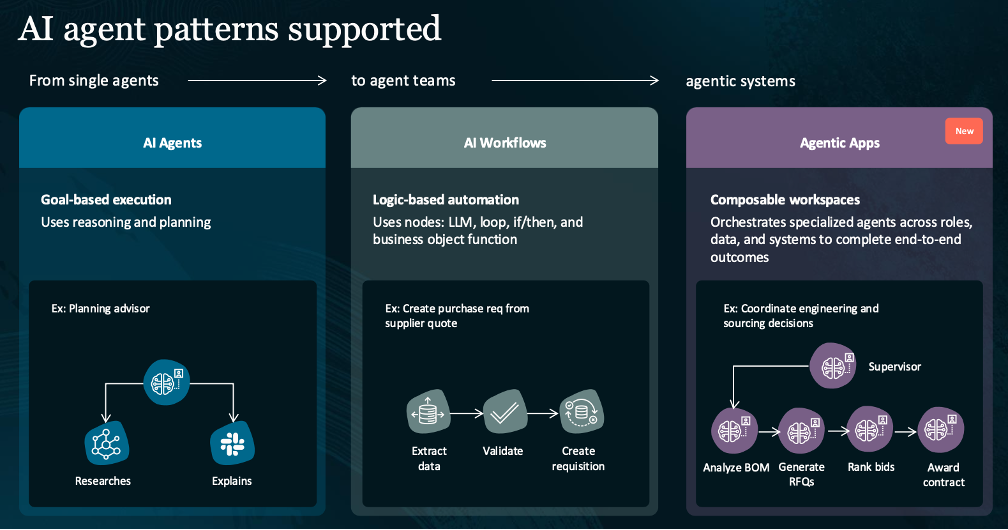
Figure 2—Oracle Fusion AI Agent Patterns Support New Agentic Apps
(Courtesy of Oracle)
Design-to-Source Workspace
Released as part of the initial 22 Fusion Agentic Applications in March 2026, the Design-to-Source Workspace is built directly into Oracle Fusion Cloud Supply Chain & Manufacturing. Designed to help procurement and supply chain teams accelerate sourcing and reduce product costs, the application provides an AI-guided environment that orchestrates the sourcing lifecycle. Key capabilities include automating requests for quotes (RFQs) directly from engineering and design data, proactively evaluating and comparing suppliers based on cost, delivery timelines, and risk, and coordinating workflows to maintain continuous context across design, engineering, and negotiation processes.
Product Readiness Workspace (NPI)
Introduced in Oracle’s 26B update (May 2026), the Product Readiness Workspace is an AI-powered agentic application explicitly designed to streamline new product introductions (NPI). This workspace provides targeted tools to identify launch risks and assess supply chain impacts early in the development cycle. Its features include generating automated executive-ready briefs that cover bill of materials (BOM) completeness and compliance, as well as formulating mitigation plans by identifying change orders, quality issues, and readiness risks. A conversational chat interface allows users to interact directly with AI agents to discover what is blocking readiness or which specific components are high risk. This Product Readiness Workspace agentic application is a very good example of how agentic applications are removing administrative, data inquiry and validation, and reporting user tasks and guiding product owners to finalize and achieve product readiness approval greatly reducing the time and effort to launch new products in the marketplace. And for some companies, quicker time to product launch translate to significant increases to their products profitability.
Product 360 Advisor
Rather than being a standalone application, Oracle’s Product 360 Advisor is an AI-powered conversational agent integrated directly into the Oracle Fusion Cloud ecosystem, introduced during the late 2025 updates. It is designed to offer unified, 360-degree visibility into inventory, master data, and supplier transactions. The advisor includes automated disruption management features that flag backorders and recalls while actively recommending sourcing alternatives. It also delivers immediate product insights, answering user questions regarding product availability and usage trends.
Together, these converging tools aim to significantly reduce the cognitive load on engineering and supply chain professionals by allowing specialized agents to handle routine monitoring, orchestrate complex multi-domain workflows, and proactively resolve bottlenecks. We are excited to see the use of these AI agents to bring product development and supply chain resources together to solve overlapping complex sourcing disruptions and performance challenges.
Conclusion
So far in 2026, Oracle has demonstrated a clear and aggressive strategy to embed AI deep into the fabric of enterprise execution. Oracle’s initial PLM related agentic applications and agents illustrate how PLM data can be leveraged and incorporated to drive business outcomes. By transitioning from systems of record to systems of outcomes, Oracle is positioning tools that do not just report on business data but actively work to resolve bottlenecks and achieve targeted goals.
The introduction of 75 Fusion Agentic Applications to date, supported by a robust development studio and an expanding partner marketplace which Oracle takes responsibility to release and support, indicates that Oracle is building a mature, scalable ecosystem. They are positioning domain-specific Fusion Agentic Applications (developed by Oracle, Oracle partners, and clients) will not only automate workflows but redefine how enterprises engage with their enterprise systems, allowing workers to focus on critical process decision steps, approvals, and investigations to drive business outcomes. Oracle makes a compelling business case.
In the PLM and SCM domains, Fusion Agentic Applications like the Design-to-Source Workspace and Product Readiness Workspace show practical, immediate value for manufacturers dealing with complex product launches and supply chain disruptions. The predictable per-seat pricing model, free tier for basic models, and included AI Unit allocations should help lower the barrier to entry for organizations looking to experiment with advanced AI. CIMdata recommends that industrial companies evaluating PLM and enterprise software platforms should include Oracle in their assessment to understand how these outcome-driven agentic applications can optimize their business processes. To learn more about Oracle Fusion Cloud PLM see https://www.oracle.com/scm/product-lifecycle-management.