IFS Unleashed 2026
Key Takeaways
- IFS is sustaining strong growth while expanding beyond its asset-management foundation. Recent acquisitions and partnerships reinforce its push into AI agents, supply chains, robotics, and broader industrial operations.
- IFS Intelligence moves AI from assistance to governed execution. Cowork, Loops and Runway support human-led work, autonomous workflows, and faster implementation—with permissions, approvals, and auditability built in.
- Early customer results are promising. Examples cited substantial procurement savings, faster report conversion, dramatic reductions in maintenance task time, and major transaction efficiency gains.
- The Siemens and AVEVA partnerships have been designed to connect engineering, operational, and enterprise data. This creates the potential for trusted, closed-loop digital twins that link design intent with field performance.
- The strategic test for IFS is can all of this be executed at scale by its clients. Key questions concern governance, usage costs, measurable recovery of operational inefficiency, partner economics, and the emergence of joint customer references. IFS is well positioned to succeed.
CIMdata had the pleasure of attending IFS Unleashed 2026, held 12-16 October 2026 in Orlando, Florida.[1] More than 3,000 attended, and Mr. Moffat, IFS’ CEO, called it IFS’ biggest Unleashed yet. This year’s theme was “The Era of Limitless Industry.”
It is critical to note that IFS keeps growing. For fiscal 2025, IFS reported ARR growth of 23%, cloud growth of 30%, net customer retention of 114%, and recurring revenue at 83% of the total; first-half 2026 ARR growth was 25%, on a base that passed €1 billion in ARR during 2024.[2] Since 2024, when acquisitions such as Copperleaf and EmpowerMX deepened asset lifecycle and maintenance strengths, IFS has pivoted toward AI agents, supply chain, and robotics. Additionally, it has launched Nexus Black (see more below), acquired TheLoops, 7Bridges, and Softeon, and partnered with Anthropic, Boston Dynamics, and 1X.[3] Their internal and external investment in growing their capabilities has been impressive, and CIMdata expects it to continue as they look to stay competitive, as well as to differentiate.
Mr. Moffat’s keynote thesis was that industrial organizations run at about 60% of their potential, and the missing 40% already sits inside the business, in disconnected expertise, scattered data, and workarounds. He asked attendees where their 40% is. He added that IFS is “not arrogant enough” to think it can improve this alone, and said AI must work alongside existing systems. IFS’ Industrial Index 2026, a survey of 2,200 leaders in 14 countries, found frontline workers moving faster on AI than governance can keep pace, and IFS research reports that 43% of respondents introduced agentic digital workers in the past year.[4] This framing resonates with CIMdata’s PLM work, where engineers lose time searching for and reconciling data; the test is whether clients measure their 40% up front and track its recovery.
The headline announcement, on 13 October, was IFS Intelligence: a single conversational interface that reasons across live IFS and third-party data, shows its sources, and acts within rules the business sets. Its three modes, shown in Figure 1, are Cowork (a person leads, actions run after approval), Loops (digital workers run defined workflows and escalate when judgment is needed), and Runway (plain-language requirements speed IFS migration, configuration, and extension). The Industrial AI Harness provides the governance: the AI inherits the user’s permissions, write-backs need approvals, audit trails are end-to-end, and no raw data goes to external AI providers. CTO Vaibs Kumar summarized the philosophy as “When AI is unsure, a person decides.” IFS sells it as an enterprise-wide license with a fair-usage cap rather than credits, unlike consumption pricing elsewhere. CIMdata sees governance as the real differentiator; with industrial data being intellectual property and must become a regulated record—the same concern PLM users raise about AI acting on product data.
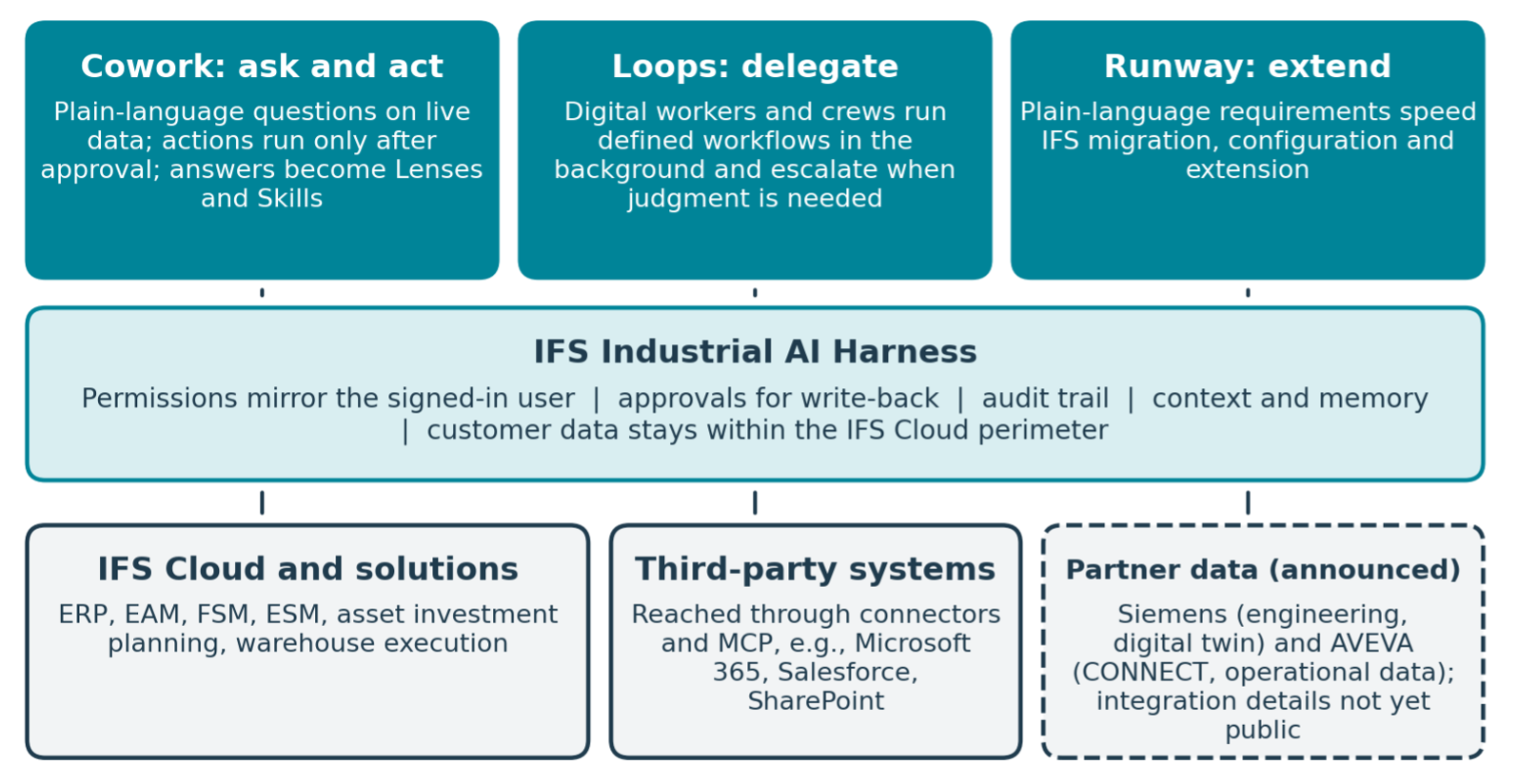
Figure 1—IFS Intelligence: Three Modes on a Governed Platform
(Source: IFS)
Customer evidence came from Nexus Black and Loops. Ms. Kriti Sharma, CEO of Nexus Black, brought William Grant & Sons, which uses Resolve, Nexus Black’s AI assistant for frontline service and maintenance workers, at a distillery with implementation in 12 weeks, identified over $10 million in potential procurement savings, and converted 48 of 50 sample reports in 30 minutes against a 200-day plan. Mr. Mo Dawood, CIO of Eight Group, said Resolve was live within two weeks, cutting a 25-minute fuse-recording task to about a minute. Ms. Somya Kapoor, CEO of Loops, showed seven digital workers across crews handling a critical pump repair from email to closure, and announced Agent Studio, with about 150 pre-built skills on which customers build their own workers; Kodiak Gas Services reported an estimated 85% efficiency gain on transactions handled by one agent.
Implementing IFS software itself was addressed from two directions. IFS says AI has cut implementation time and effort by an average of 84% across 15 or 16 specific activities in IFS Cloud implementation projects, though not by that much in overall project duration. They also announced a partner AI marketplace where partners can build and sell skills (repeatable routines), lenses (saved live views of operational data), and automations on IFS Intelligence, with partners getting free access through December 2026 and commercial terms not yet disclosed. Arcwide, a Platinum IFS partner and the largest IFS-dedicated integrator, highlighted its embedded delivery model, an AI-driven implementation methodology; its Arcwide.ai offering applies AI across fit-gap analysis, specifications, testing, and hypercare. CIMdata expects tension: if IFS tooling and partner methods both compress effort, partner economics change, and clients should expect savings to show in project scope and price.
The Siemens Digital Industries Software partnership, announced earlier this year (29 June 2026) and followed up at Unleashed by a joint go-to-market strategy presentation, drew the most interest from CIMdata’s PLM community. Siemens contributes engineering, simulation, manufacturing, and digital-twin context, while IFS contributes asset management, service history, and frontline operational data, aiming for a closed-loop digital twin grounded in both design intent and field performance. Mr. Tony Hemmelgarn, CEO of Siemens, joined the opening keynote. To show how it could work, Siemens and IFS highlighted a pilot with Doppelmayr, the ropeway maker, which has run IFS for 15 years and also uses Siemens Designcenter and Teamcenter. Siemens engineering and Teamcenter are coupled via Siemens’ Intelligence Center X with IFS Intelligence to give the AI access to asset and service elements and close the loop. In this context, Siemens’ Intelligence Center X acts as an industrial AI orchestration and knowledge-graph foundation, uniting enterprise data, industrial ontologies, physics-based simulations, and digital twins. When linked with IFS Intelligence, the intelligence layer reasons over live operational data from both Siemens systems and IFS enterprise asset management (EAM), field service, and ERP systems without building heavy, bespoke integration layers. This solution matters because Siemens customers rarely see how designs perform in service, while IFS customers maintain assets without the engineering definition behind them. Linking the two gives AI agents data they can trust in live operations.
The AVEVA partnership, announced in May of this year, is the operational-data counterpart: it combines AVEVA CONNECT data with IFS asset investment planning and EAM (including Copperleaf and Ultimo) to help owners decide whether to repair, defer, or replace.[5] Together, Siemens supplies engineering, AVEVA provides operational and engineering intelligence, and IFS the enterprise execution layer between them.
Physical AI was the final thread. Mr. Andy Pratt, corporate vice president of Microsoft’s emerging technologies group, showed a humanoid robot working with IFS and argued that decisions on critical infrastructure depend on more data in more places, as long as it is trusted. This builds on IFS’ 2025 work with Boston Dynamics and 1X, and Mr. Moffat cited partnerships with Anthropic, Microsoft, and OpenAI. CIMdata’s view: robots become useful to industry once tied to asset and work-management contexts, which is exactly what IFS provides.
Conclusion
Where IFS Unleashed 2024 was about generative AI assisting users, Unleashed 2026 was about AI doing the work within an appropriate governance structure that industrial customers can trust. IFS paired a clear launch with credible customer examples, pricing designed for broad use, and partnerships reaching toward engineering and operational data. Open questions remain, including how the Industrial AI Harness holds up at scale and what usage will cost, whether Siemens and AVEVA produce joint reference customers and what they mean for the PLM data model, and how partners adapt as AI compresses implementation efforts.