B2B software solution providers' efforts to streamline their Go-To-Market (GTM) strategies often pay off. Our experience shows that some solution providers have generated savings of 25% while increasing sales by 15% over three years; others have seen their partners' contributions triple, and others have increased the size of strategic deals by five times.
Here's how they did it.
Too often, technology companies try to sell their solutions based on product features (e.g., price, technical performance, functionality) to reach the broadest possible customer base. Yet, customers are not interested in the products themselves but in what those products can do for them. It is precisely the role of marketing and sales to articulate this value and define how it will be delivered to customers and the market.
The GTM strategy of technology manufacturers is a fundamental element of their business performance, and it becomes even more critical when the sale is complex. For B2B software solution providers, selling the business value of their offering has become a must, but implementing value selling brings profound changes in sales organizations that are accustomed to selling more technical performance at a given price than solving a specific problem.
Adjusting the GTM strategy to a solution sale or a business impact sale is complex because it potentially addresses several dimensions and carries important consequences. Such an adjustment requires asking the right questions in the right order.
ASK THE RIGHT QUESTIONS IN THE RIGHT ORDER
A technology manufacturer's GTM strategy, or how it addresses its markets, depends on what its customers buy in terms of products, solutions, and services to meet a comprehensive need. This need is defined by the reason customers invest in technology, i.e., “why” customers need to invest in technology. The "Why" explains the customer's complete need, which is often only partially met by the technology, while the comprehensive "What" allows for a better definition of "How" and with whom the technology sale will meet the customer's need.
To define "How" to sell the business value of the technology, it is therefore first necessary to identify the "Why" and the "What" of the customer’s need.
THE WHY DEFINES THE WHAT
Customers may want to acquire technology for tactical, operational, or strategic reasons. Depending on these reasons, the solution's components will differ and call upon partners with various profiles. Thus:
- For a tactical need, such as purchasing a feature (e.g., an antivirus program, a CAD tool, a digital simulation tool), the customer needs a product, product selection support, installation, and training.
- For an operational need, such as automating or streamlining existing operations and processes (implementing an ERP, an MES, or a digital twin), it will be necessary to design target processes, select a solution, configure the solution and integrate it into an existing environment, manage the deployment program, and in particular the change brought about by the solution. Then, the achievement of the value promised by the project must be measured. Selling is already much more complex, not limited to technology, and involves many players.
- Finally, for a more strategic need, the complexity increases further. Let's take the example of licensing the products a company sells, which has been well-known since the emergence of SaaS models. The introduction of the "product as a service" concept is strategic because the company is transforming its offer and its positioning, which impacts the company's business model, the nature of the relationship it establishes with its customers, the services it will have to offer, and the price positioning of the new offer, which must not cannibalize the old one. The technologies chosen must be able to implement new operating modes (service level measurement, long-term customer relationship management), new management modes (service contract management), and new processes. They must be operated by new roles in new organizations, and they must be in line with the business plan that led to the investment. Technologies must be part of a strategy and only be sold if they serve that strategy.
Therefore, the sale of technology products or solutions must always be repositioned within the customer's exhaustive and complete need. This highlights what the customer will buy and what type of player it will be bought from. The more strategic the need, the more complex it is, and the broader the spectrum of internal and external stakeholders to be coordinated. The more complex the sale, the more necessary and sophisticated the organization of all the participants is.
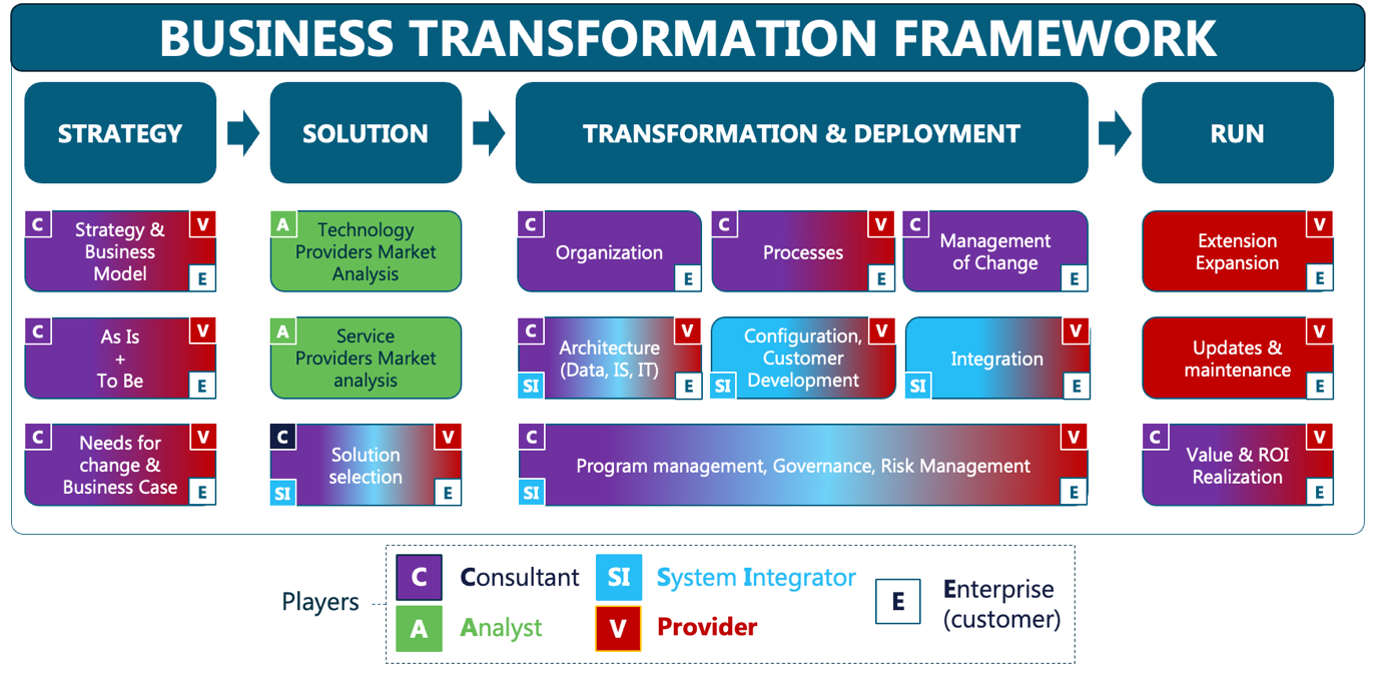
THE WHAT DEFINES THE HOW - THE GO-TO-MARKET STRATEGY
The value proposition is the starting point of a robust and well-thought-out GTM strategy.
The positioning of the technological offer within a business need (i.e., the value proposition of the offer) is the starting point of its GTM strategy since it is the value proposition that defines the type of customers that the solution provider will address and the type of partners with whom the proposition must be sold.
For the same offer, there can be multiple value propositions. They will depend mainly on the sector of its customers (the needs of the private sector differ from those of the public sector, for example) and on the use cases put forward (improving the efficiency of the existing system, making it more agile and flexible, or enabling innovation), but can be completed by more detailed contextual elements such as the timeframe of the realization of the promises made, level of return on investment, modernization, and preparation for the future...
Each value proposition is the subject of a specific ecosystem of internal and external partners that will position it relative to the customer's needs. Value propositions define the types of partnerships needed and the organization of the solution provider’s sales force: Verticals, Sales, Pre-sales Engineers, Value Engineering, Evangelists, Partnerships, and Services.
Quantitative market analysis as a condition for profitable operations and a detailed sales organization
Some customers are less profitable to serve than others. Their investment capacity is a key factor in aligning sales costs with expected benefits. Ultimately, it helps define the ideal sales force structure to address the market based on its potential.
When the profit-to-cost ratio (the 'Sales Cost Ratio')—which varies by sector, company strategy, and market conditions—exceeds a certain threshold, a direct sales force is viable. If the profit-to-cost ratio falls below this threshold, an indirect sales force is needed to maintain profitability.
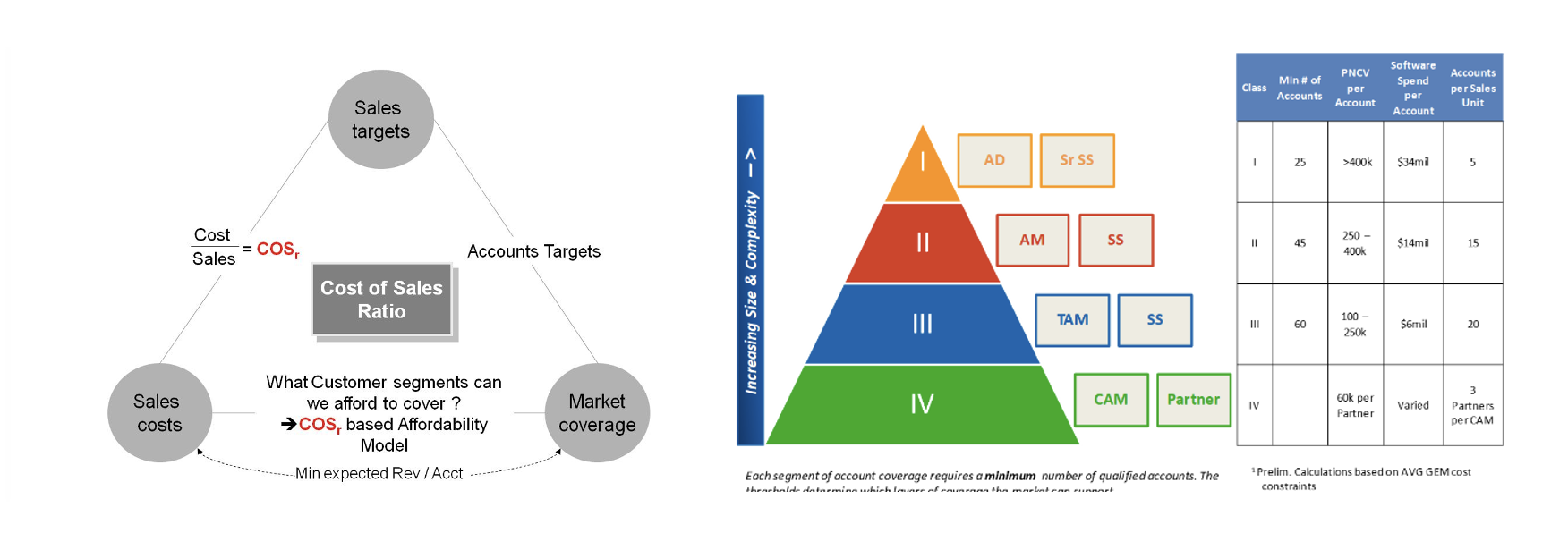
The quantitative analysis of the markets, coupled with the value propositions offered by the solution providers (which often distinguish the sectors in which the customers operate), is the basis for the company’s market segmentation, which defines the "sales motion" in each segment (direct sales, indirect sales) but also the size and objectives defined in the previous step.
The partners are a natural and necessary complement to implementing the GTM strategy.
Most of the customer segments thus defined require the intervention of one or more partners, whether it is a direct or indirect sale. Depending on the segment, partners may serve as an extension of the solution provider’s sales force, a complement to it, or both:
- Partners in an indirect sale are mostly value-added resellers (VARs), local scope system integrators associated with distributors, or technology partners who combine the solution provider’s technology with their own. The contractualization of the relationships allows a general economic balance that benefits all stakeholders (solution provider, partner(s), customer), allowing market coverage that would not be achievable alone.
- Partners in a direct sale are often, for their part, carriers of the business value of the global offer. They position the value of the technical offering in an end-to-end customer transformation process. These partners are most often consultants or large systems integrators but can also be technology partners.
Solution maturity, a qualitative element of a GTM strategy
The technical maturity of the solutions depends on the difficulty of their sale and deployment. Thus, the more mature and proven the solutions, the more capable the partners are of integrating or installing them efficiently instead of the solution provider.
Consultants, in general, are interested in the competitive advantages that a solution can provide to their clients. They, therefore, always intervene very early in the value proposition. Conversely, VARs are exclusively interested in the margin they make on each sale, which leads them to focus only on proven, mature, easy-to-deploy solutions. Between the two, a combination of partner models co-exist:
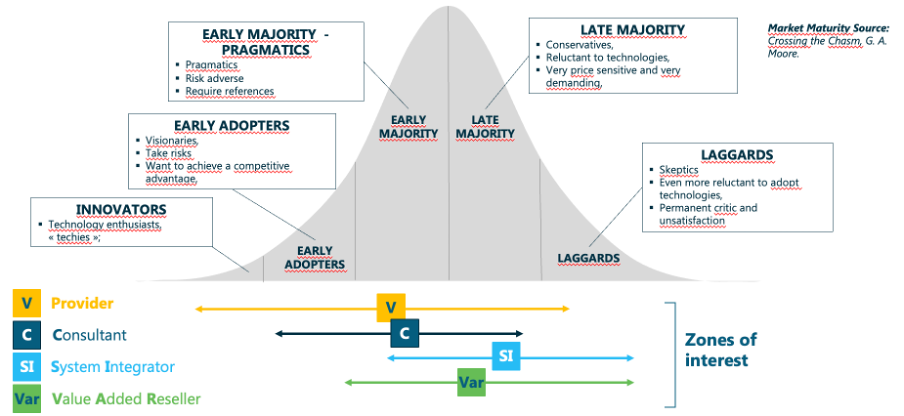
A MAJOR TRANSFORMATION
Most technology solution providers have historically focused more on the technical characteristics of their offerings than on their marketability, even though this is fundamental and critical to their commercial success.
However, marketing these offerings must follow a rational approach based on positioning the technical offering within a business value approach proposed to the customer. Our experience shows that a properly tuned and rationally defined GTM strategy can reduce coverage costs by 25%, increase sales by 15%, increase the size of strategic deals by 5 times, or triple the contribution of value partners.
The resulting transformation effort is substantial for manufacturers used to selling a product or a combination of products and services:
- Sales forces must develop a business value approach to selling, not a technology one.
- Including evangelists and solution architects in the sales force, must be done with care and attention to limit cultural clashes with sales forces that are used to selling products.
- Technology's share of the overall project will decrease as sales become more strategic, and the sales cycle time will tend to increase.
- Sales will be much less replicable as they will be much more personalized.
- New partners will need to be identified, introduced into the sales process, and managed by resources that know and understand them.
- Including partners with different cultures, habits, and processes will require careful attention to avoid culture shock.
Transforming a GTM strategy from product-based selling to value-based selling is as much technical and economic challenges as cultural.
Please let me know your thoughts on this topic by sharing them in the comments section of this blog!
Or contact me directly at Diese E-Mail-Adresse ist vor Spambots geschützt! Zur Anzeige muss JavaScript eingeschaltet sein!
Laurent