PDF
PDF
Unifying Engineering Data, PLM, and AI to Accelerate Manufacturing Performance
Takeaways
- Manufacturers cannot achieve an end-to-end digital thread without integrating data across CAD, PLM, ERP, and simulation systems. Fragmented technical data disrupts manufacturing planning, slows NPI/NPD cycles, and complicates lifecycle traceability.
- AI-driven manufacturing depends on unified and contextualized engineering data. Without consistent structures, attributes, and change information flowing downstream, advanced capabilities like copilots, RAG search, MCP-driven automation, and predictive insights cannot be deployed meaningfully.
- Modern product manufacturing operations require workflows and PLM extensions that reflect real engineering-to-manufacturing processes. Out-of-the-box systems rarely provide the level of configuration, traceability, or lifecycle continuity that manufacturers need.
- AMC Bridge brings deep experience across engineering APIs, PLM platforms, simulation environments, along with enterprise integrations, and business process understanding, enabling manufacturers to eliminate data silos and build synchronized digital-thread pipelines.
- Real customer outcomes—such as automated BOM creation, simulation data integration, PLM modernization, and compliance automation—demonstrate measurable improvements in manufacturing readiness, quality, planning, and supply chain coordination.
Introduction: Product Manufacturing Industry Challenges
Despite decades of investment in CAD, PLM, ERP, and manufacturing execution technologies, many manufacturers continue to operate with fragmented and disconnected engineering data.[1] Product definitions are often scattered across multiple systems, formats, and organizational silos, leaving manufacturing teams to reconcile incomplete or inconsistent information. The result is supplier confusion, production errors, rework, and delayed production cycles—outcomes that directly undermine cost, quality, and delivery performance.
The challenge is further amplified by rising product and process complexity. Manufacturers must contend with an expanding number of variants, increasingly hybrid electro-mechanical products, and evolving regulatory and compliance requirements. These pressures expose the limitations of legacy systems that were architected primarily for engineering-centric activities rather than holistic lifecycle execution. As a result, sustaining accurate product definitions and consistent change histories across engineering, manufacturing, and supply chain functions becomes progressively more difficult.
Manufacturing readiness processes such as bill-of-material (BOM) creation, change propagation, and documentation management frequently rely on manual or semi-manual steps. These activities are time-consuming and error-prone, and delays in one area quickly cascade into procurement, manufacturing engineering, and production scheduling. As a result, organizations struggle to meet aggressive NPI/NPD timelines while maintaining quality and compliance.
Simulation data represents another persistent challenge. While simulation is widely applied within engineering organizations to validate designs, assess performance, and reduce reliance on physical prototyping, simulation results are frequently confined to engineering silos. When this data is not systematically connected to PLM and manufacturing engineering workflows, critical manufacturability insights—such as tooling requirements, process constraints, and production risks—fail to inform early decision-making. These issues are then discovered later in the lifecycle, where corrective actions are more disruptive and significantly more costly.
From a digital thread perspective, traceability across engineering, procurement, manufacturing, and quality domains often lacks the connectivity required. When requirements, designs, BOMs, supplier data, and production records are not persistently linked through an authoritative digital backbone, organizations struggle to propagate change consistently, govern supplier relationships, and maintain a reliable system of record across the lifecycle. These breaks in the digital thread are particularly evident during audits, regulatory reviews, and quality investigations, where end-to-end visibility and data lineage are essential.
Finally, many manufacturers are eager to deploy AI-driven capabilities, from copilots and automated documentation to predictive analytics and intelligent automation. However, these initiatives often stall because lifecycle data remains fragmented, inconsistent, unstructured, or inaccessible. Without an interconnected digital thread, AI solutions lack the reliable context required to deliver meaningful value, limiting their impact to isolated pilots rather than enterprise-scale transformation.
What Product Manufacturers Need to Enable the Digital Thread
To address these challenges, manufacturers must establish a digital thread that connects engineering, manufacturing, quality, and supply chain processes through consistent and trusted dataflows. When engineering data flows seamlessly into manufacturing engineering, operations, and downstream functions, design intent, product structures, and simulation outputs remain aligned throughout the lifecycle.
Automation plays a critical role in enabling this continuity. Automated and configurable data transformation reduces reliance on manual steps and improves both speed and accuracy. Capabilities such as automated BOM creation, structured change-package propagation, and compliance workflows allow manufacturers to prepare for production more efficiently while reducing errors and rework.
Simulation data integration is equally important. By embedding simulation results directly into engineering and PLM environments, manufacturers can support earlier manufacturability and performance assessments, inform tooling and process decisions, and identify risks before designs are released. This integration reduces prototype cycles and strengthens production planning by shifting critical decisions to be taken earlier in the lifecycle.
AI readiness depends fundamentally on data quality and structure. AI-driven manufacturing capabilities—including copilots, retrieval-augmented generation (RAG) search, MCP-driven automation, automated documentation, cost estimation, and predictive insights—require reliable, contextualized data from across the lifecycle. A unified digital thread ensures that AI systems can access consistent product definitions, change histories, as well as process and product performance information.
PLM modernization efforts further highlight the importance of clean and validated data. Whether migrating to a new PLM platform or integrating multiple systems, manufacturers must ensure that engineering and manufacturing data are well structured during transitions. Doing so avoids downstream disruptions and establishes a scalable foundation for future automation and analytics.
AMC Bridge’s Digital Transformation Approach
Engineering-Manufacturing Interoperability
AMC Bridge helps manufacturers integrate CAD, PLM, ERP, and simulation systems to create continuous, reliable dataflows that manufacturing teams can trust. By leveraging deep expertise across engineering APIs and enterprise platforms, AMC Bridge eliminates the need for manual data re-entry and reduces inconsistencies across systems.
This interoperability accelerates release cycles and supports synchronized change execution across planning, sourcing, and production. In one example, AMC Bridge automated cross-platform BOM extraction for a cloud-based manufacturing tool provider, eliminating manual entry and improving alignment between RFQ processes, purchasing, and MRP execution.
- Client: A U.S.-based SaaS provider offering cloud-native tools for managing product data and streamlining collaboration across engineering and manufacturing teams.
- Business Challenge: Manufacturers needed to automate the creation and updating of BOMs across CAD, ECAD, PLM, and ERP systems. Manual, error-prone processes caused delays, inefficiencies, and unnecessary financial loss.
- Solution and Impact: AMC Bridge delivered automated BOM management that eliminated manual entry, reduced errors, and improved reliability for complex assemblies. Integrations enabled consistent, cross-platform data flow across CAD, ECAD, PLM, and ERP systems, keeping product information synchronized throughout the lifecycle. As a result, downstream processes—including RFQs, purchasing, and MRP—became more efficient and accurate. The solution was designed for scalability, giving the client a foundation that can evolve with future product and business requirements.
Digital Thread and PLM Modernization for Manufacturing Readiness
AMC Bridge configures and extends PLM systems to better support manufacturing engineering workflows, documentation management, release processes, and configuration handling. Rather than relying solely on out-of-the-box functionality, AMC Bridge tailors PLM environments to reflect real engineering-to-manufacturing processes.
Integrated PLM–ERP environments help manufacturing teams maintain accurate product definitions and execution data. For a leading R&D-driven manufacturer, AMC Bridge unified Aras, SAP, MCAD, and SharePoint into a single source of truth, improving lifecycle traceability and ensuring manufacturing readiness across the enterprise.
- Client: A premier research and development center addressing complex technological challenges across electronics, integrated systems, cybersecurity, and aerospace innovation.
- Business Challenge: The client operated in an engineer-to-order environment with fragmented workflows and disconnected systems, including Aras, SAP, MCAD, and SharePoint, resulting in poor traceability and operational inefficiencies. A highly customized manufacturing execution system supporting prototyping workflows added further complexity, requiring seamless integration and tailored process support beyond standard PLM capabilities.
- Solution and Impact: AMC Bridge implemented a scalable solution within Aras Innovator to centralize data and establish a single source of truth. By automating routine workflows and reducing manual effort, the solution improved accuracy, consistency, and collaboration across engineering and manufacturing. Advanced planning capabilities—including AI&T,[2] MPP/MER,[3] and parts planning—were enabled and integrated with SAP to support cost-effective, timely delivery of highly engineered products. The combined system unification, process automation, and planning support provided a foundation aligned with the client’s complex ETO and prototyping workflows, improving visibility, traceability, and operational control.
Regulatory, Compliance, and Supplier Automation
Regulatory compliance and supplier coordination depend on accurate and timely data exchange across the digital thread. AMC Bridge supports regulatory, compliance, and supplier automation through configurable data transformations that reduce manual effort and improve consistency.
Automated BOM creation and change-package propagation are positioned as high-ROI automation use cases that directly improve readiness for production and downstream coordination. By eliminating data silos and connecting complex applications, AMC Bridge reduces manual steps in manufacturing readiness processes and strengthens lifecycle traceability across engineering-to-manufacturing handoffs.
- Client: A long-established niche technology provider specializing in transforming fragmented and unstructured information into usable insights for organizations managing complex product lifecycles. Their solutions support engineering and procurement teams by enriching internal and external data and integrating it into enterprise workflows.
- Business Challenge: The client needed to streamline product data handling and regulatory compliance workflows for manufacturers and government agencies. Manual, error-prone data processing, strict accessibility requirements such as Section 508, and the need to process extremely large data volumes—up to two million records per day—created significant efficiency and scalability challenges.
- Solution and Impact: AMC Bridge developed a centralized web portal to manage product and supplier data in a scalable, structured environment. To further reduce manual effort, a MS Word add-in was created to automate reference management directly from the client’s service, improving consistency and simplifying compliance-oriented documentation. Together, these solutions improved operational efficiency, reduced errors, accelerated processing, and established a flexible, future-ready foundation to support regulatory, supplier, and compliance-related operations.
Simulation Integration for Manufacturing Optimization
AMC Bridge ensures that simulation data does not remain isolated within engineering organizations but instead informs manufacturing decisions earlier in the lifecycle. Simulation integration is explicitly identified as a high-ROI use case that improves production planning and reduces late-stage risk.
Simulation is also highlighted as part of AMC Bridge’s cutting-edge technology experience, alongside digital twin and data analytics. The outcome is fewer late-stage surprises, improved manufacturability insights, and more predictable production planning driven by earlier access to simulation results.
- Client: A global company that develops specialized digital tools enabling organizations to virtually explore how complex systems behave under various conditions. Their technology supports early decision-making in product development and is widely used in industries where precision, safety, and performance are critical.
- Business Challenge: The client needed a more effective way to manage simulation data, support engineering decision-making, and connect multiple simulation and optimization tools into a unified ecosystem. Manual data transfers introduced errors, simulation information was fragmented and insecure, global collaboration was limited, and both cloud and on-premises deployments had to be supported. Verification reporting was particularly difficult due to distributed and inconsistent data.
- Solution and Impact: AMC Bridge built an integrated simulation environment on Aras Innovator to support end-to-end simulation workflows. Responsive, user-friendly interfaces made large-scale simulation data easier to manage, while diverse simulation and optimization tools were unified into a cohesive platform. Enterprise-grade QA practices and scalable architecture enabled secure data handling, improved verification reporting, global collaboration, and reliable support for both cloud and on-premises deployments.
AI-Enabled Manufacturing Intelligence
AMC Bridge combines deep integration experience with emerging standards expertise to facilitate AI-enabled manufacturing offerings. The company has demonstrated hands-on experience with the Model Context Protocol (MCP) to support traceability, compliance, and streamlined workflows across engineering toolchains. Figure 1 illustrates the breadth of process integration AMC Bridge offers.
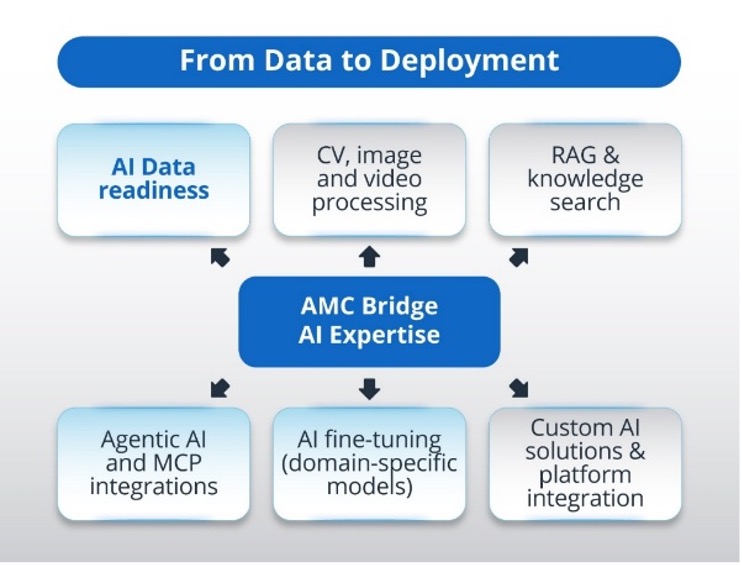
Figure 1—From Data to Deployment
(AMC Bridge)
Examples include creating intelligent linking environments that connect hardware design platforms, such as KiCad, with requirements management systems, such as Codebeamer, to ensure data consistency and actionable insights. AMC Bridge is also actively exploring AI-powered approaches to connect platforms such as Autodesk Construction Cloud and Procore, to extract model quantities, visualize progress, and align data with cost codes and locations.
Through phased MVPs,[4] dry-run approvals, and robust mapping services, AMC Bridge ensures these AI-enabled workflows are auditable, scalable, and enterprise-ready. By establishing a unified lifecycle data pipeline, manufacturers can move AI initiatives beyond pilots and into production environments where they deliver sustained value.
Engineering Software Expertise Supporting Manufacturing
AMC Bridge’s software development experts bring extensive experience with APIs across major engineering software platforms. Their ecosystem coverage spans CAD systems, application and data platforms, BIM,[5] CDE,[6] PDM, and PLM environments such as Teamcenter, Windchill, Aras, and Autodesk platforms.
In-depth knowledge of computational geometry and 3D visualization further enables AMC Bridge to extend and connect engineering software environments into manufacturing-facing workflows. This technical foundation allows manufacturers to overcome data silos and integrate engineering systems in ways that directly support manufacturing execution.
Conclusion
Manufacturers seeking to improve speed, quality, and operational predictability must close the persistent gap between engineering and manufacturing. Fragmented data, disconnected systems, and manual processes continue to undermine manufacturing performance and limit the impact of digital transformation initiatives.
Establishing a connected digital thread requires integrated systems, unified dataflows, and workflows designed around full lifecycle needs—not just engineering tasks. CIMdata believes that AMC Bridge provides the interoperability, PLM modernization, simulation integration, AI foundations, and data quality capabilities necessary to enable this transformation.
By investing in these capabilities, manufacturers can accelerate NPI/NPD cycles, improve manufacturing readiness, reduce errors and rework, and position themselves for scalable AI-driven innovation. For organizations seeking to bridge the engineering–manufacturing gap and fully leverage the digital thread, CIMdata recommends evaluating AMC Bridge’s capabilities as a proven and trusted integration partner.
For more information about AMC Bridge, see their website.