PDF
PDFThe choice of the company’s new Product Lifecycle Management (PLM) system has been made and the team of decision makers celebrates the challenging selection effort. But now the real work begins—planning and executing the migration of data from the current legacy systems to the new target PLM platform. A company’s existing data contains a significant portion of their intellectual property (IP) and therefore the company’s competitive advantage and value. The success of the new system depends heavily upon an effective migration of existing data in an intelligent, quality, and timely manner.
This scenario is repeated in varying degrees across the globe and in every industry vertical. With the rapid pace of improving technology, competitive pressures drive many companies to continually evaluate their PLM solutions and undertake improvements. The decision may be driven by the recognition that their current legacy solution, or more often their maintenance of multiple legacy systems, has grown outdated. Also, one common driver is the consequence of a new company acquisition and the realization that consolidation of their different PLM solutions is warranted. Yet another scenario may be the result of a major customization of the current platform. Regardless of the driving reason for change, the effective accomplishment of the change will depend on successful data migration from the existing to the new.
The Data Migration Challenge
Data migration brings numerous issues to the forefront. It may represent the first time in many years that a company has revisited their choice of a product development data model. In order to overcome perceived weaknesses in that data model that have developed over time, the company may wish to alter portions of the model or expand on its definition. In either case, those changes put extra pressure on the migration from old to new as a straightforward data migration may not be possible.
One critical aspect of a migration is to first identify all the data that is subject to consideration. While many will look at the problem as being solely a digital data to digital data transfer, experienced individuals in the company will likely recognize that some portion of the company’s critical IP may still be in hard copy form or reside only in the minds of their most senior colleagues.
Once the data subject to migration has been identified, a process of validating its correctness must be defined and executed. Often data may be out of date because last minutes changes were not rolled back into earlier versions of the product data. Additionally, duplicate data is frequently in use (or being maintained in multiple systems), forcing first a check for consistency and then data cleansing. Determining the full scope of data migration requires leveraging the knowledge of experienced individuals within the company.
Possibly one of the biggest issues of the data migration challenge is that of timing the migration. Legacy data will continually grow since the company cannot stop development and wait for the new PLM implementation to be complete. Also, realistically the migration team has a limited timeframe to make the actual switchover—possibly a weekend or holiday shutdown. That requires migration algorithms with special tools to fit the migration into the available time window as the data being migrated can easily include hundreds of thousands (or millions) of data records.
The PRION Group Solution
PRION Group’s (PRION’s) PRIMA tool suite for PLM data migration draws on their eleven years of experience in the industry with PRION recognized as a leading player in PLM data migration. Because the PRIMA suite includes libraries of PLM migration tools and processes PRION does not have to develop (or re-develop) interfaces to most common PDM and legacy systems from which data must be migrated. They also have many years of migration services experience and expertise. This depth of understanding enables PRION to quickly develop a migration plan tailored to a specific company and rapidly execute the migration to minimize impacts on product development and production
As shown in Figure 1, PRION has evolved their migration process into distinct steps of exporting, validation, data mapping, and loading, applying specific controlled rules to each phase.
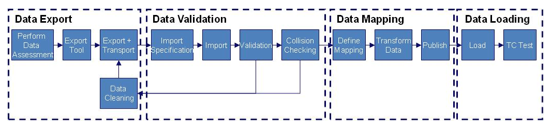
Figure 1 - Migration Process
Most importantly, many customer PLM migration projects proved that it is an impossible challenge to migrate data directly from a source PLM system to a target PLM system. Factors that must be addressed are data gathering from multiple sources, transformation and cleansing, validation, and loading into the new system(s), which may be physically distributed. PRION recognizes that there are unacceptable risks to a company when transitioning to a new PLM platform. To mitigate these risks, PRION has developed the PRIMA PLM migration tool which uses an intermediate migration database of PRION’s design (see Figure 2). Data is exported to the intermediate PRIMA database and transformed there before being loaded into the target PLM platform. This approach does not force an immediate change over from the legacy platform to the new platform and business may continue as usual while the data migration mappings are developed.
A critical migration success factor is setting up a change management system to not only track modifications made during the data migration itself, but also changes to the data after being loaded into the new PLM platform. This change management system must support the customer’s specific requirements throughout the migration process and into production in the target environment.
PRION reports that 98% of all the data check and data mapping rules in most customer data migrations are available in the PRION PRIMA tool. The data transition scripts are coded in eXtensible Markup Language (XML). The use of XML for machine-readable data emphasizes simplicity and usability. The fact that PRION can use many of the migrations scripts already in their extensive library which has been developed for past clients lowers migration risks and reduces costs for future PRIMA migration customer significantly. This approach helps in the many difficult migration scenarios where the target system is a multi-site solution.
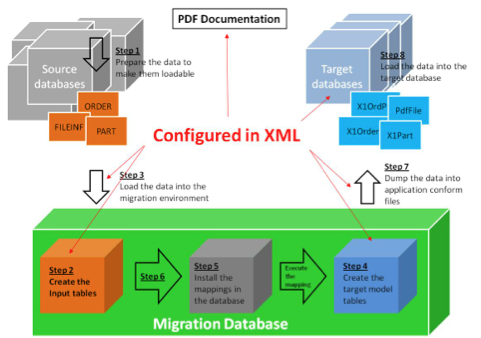
Figure 2 - PRION's PRIMA Tool Flow
Summary
PRION’s solutions are being used for many different companies and their data migration situations and projects. PRION Group has a special strategic alliance with Siemens PLM Software for PLM and CAD implementation and the migration of related data. PRION reports that they are responsible for Siemens's own internal data migrations in the Siemens Industry division (IEC Program), where PRION uses its PRIMA tool and migration experts to support successful data migration for a high number of legacy and outdated PLM systems. Other data migrations have been performed for Bombardier, Alstom, Daimler and other well known companies.
PRION has become a leader in data migration for the PLM industry. The challenge of data consolidation and migration is a decisive element in achieving the return on investment of a new PLM platform decision. PRION’s data migration expertise, tools, and solutions execute the information migration process while enabling productive usage of the legacy source systems until final cutover. Companies that are upgrading or replacing important business and product development systems should consider PRION to assist them with their data migration needs.
For more information on PRION Group and their services, see www.PRION-group.com.