 Decarbonization, the use of renewable energy, electric mobility, heating solutions, and the energy transition will only occur if a smart, secure, distributed grid is completed in time. A simple analogy would be building a house without a foundation. Now, let’s project out to 2030. Suppose you recharge your electric vehicle (EV) with electricity from the existing grid. In that case, the energy could still originate from fossil fuels because an intended renewable energy project was not completed or could not connect to the existing grid. In this scenario, the EV helps our decarbonization efforts, but the energy used to make the electricity doesn’t. Ideally, we would recharge EVs with electricity over a smart grid from renewable sources with zero emissions.
The Bottleneck
The energy sector is the largest contributor to CO2 emissions, adding 14.65 gigatonnes in 2022. The faster we add clean and renewable energy sources and reduce the use of fossil fuels in power generation, the better chance we have of limiting temperature increases to 1.5°C above pre-industrial levels as outlined in the Paris Agreement.
Right now, the grid is the bottleneck in the transition to net zero emissions. There are at least 3,000 gigawatts (GW) of renewable power projects, with 1,500 GW in advanced stages, waiting in grid connection queues, roughly five times the amount of solar and wind capacity added in 2022.
Today, global average surface temperatures are around 1.2°C above pre-industrial levels, primarily due to burning fossil fuels (coal, oil, and natural gas). These and other greenhouse gases (GHG) trap the sun’s energy in the earth’s biosphere, which causes global warming. Global warming leads to a whole host of climate change-related calamities, such as melting ice caps and glaciers, floods, heatwaves, wildfires, and ocean acidification, to name a few.
To keep the planet’s long-term temperature below 1.5°C, the goal is to reach net zero emissions by 2050. Realizing this goal requires adding or replacing 80 million kilometers of power lines by 2040—equal to the entire global grid.
The International Energy Agency (IEA) recently released its World Energy Outlook 2023. This is a yearly report that takes an in-depth look at global energy. While far from a rosy report, it shows progress against the backdrop of the war in Ukraine, the attack on Israel by Hamas, and an uncertain economic outlook that includes stubborn inflation, higher borrowing costs, and elevated debt levels. Despite all the geopolitical and socioeconomic turmoil, fossil fuel prices are lower than their peaks in 2022, and clean energies, particularly solar and EVs, are doing quite well. The IEA looks at several scenarios: oil and gas use peaks by 2030 in all cases. Coal drops significantly in China, the biggest polluter, as well as in developed and developing countries.
While investments in renewable energy continue to increase—nearly doubling since 2010—investments in the grid have remained relatively static at about US$300 billion per year. There are exceptions, such as Australia, which is well underway for a smart grid to be in place by 2025. South Australia has not had baseload power from coal or fossil fuels since 2016, with no major outages. Others, like the United States, have just awarded US$3.5 billion in a first phase, targeted at the modernization of the grid to accommodate renewable energy. This is the largest single investment the United States has ever made in its grid.
Ramifications of the Delay
The problem with delaying investments in the grid is that it substantially increases global carbon dioxide (CO2) emissions. According to the IEA, this inability to bring renewables online will result in higher use of fossil fuels in the power sector. This scenario could amount to 58 gigatonnes, equivalent to the last four years’ CO2 emissions. It means the goal of limiting global warming to 1.5°C, which, in my opinion, is already in jeopardy, would now be well out of reach with a 40% chance of exceeding 2.0°C.
“We must invest in grids today or face gridlock tomorrow” – IEA Executive Director Dr. Fatih Birol
What is a Smart Grid?
The traditional grid has been delivering power to households and businesses for well over 100 years. Traditionally, fossil fuels and nuclear fission become electricity at a centralized power plant. Once converted to electricity, it flows to the consumer with the voltage cut down at substations. It ultimately travels through power lines to our homes, commercial businesses, and manufacturing sites in a one-way hierarchical flow, as shown in the diagram below.
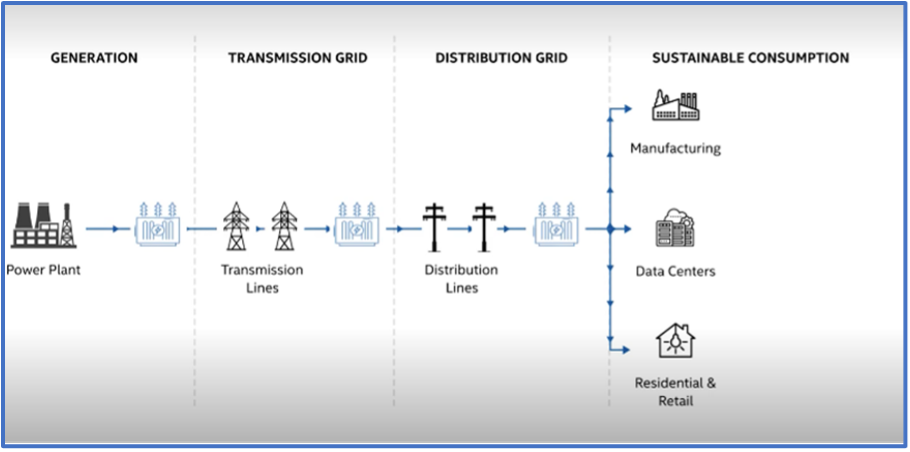
Source: https://www.weforum.org/agenda/2022/12/the-future-of-smart-energy-is-systemic-open-and-collaborative
To give you an idea of the scale, in the United States, that’s about 10,000 power plants, 55,000 substations, and 120,0000 transmission lines, which don’t include the distribution (power) lines to the consumer. This is the biggest machine in the world, consisting of three primary grids: one for eastern states, one for western states, and, of course, one for Texas, which coincidentally is the leading combined producer of solar and wind among U.S. states, doubling California’s output and has been the leader since 2006.
The world is transitioning to smart distributed grids with an omnidirectional flow to and from the many sources and users of energy to accommodate cleaner and inexpensive renewable energy sources such as solar and wind. Unlike a traditional centralized power plant, these energy sources are highly distributed because solar and wind are intermittent, as the sun doesn’t always shine, and the wind doesn’t always blow. There are also limitations to storage capacity, and transmitting electricity over long-distance transmission lines is inefficient; therefore, the decentralized grid is optimally located closer to the point of use than the traditional grid.
Smart grids are an electricity network that uses digital technologies, sensors, and software to manage supply and demand better by using real-time monitoring and control with the flexibility to distribute energy when and where it is needed most. By doing this, the smart grid acts as a two-way communications channel between the consumer and supplier, thus dramatically reducing waste and lowering consumer costs.
Consumers are also beginning to invest in smart home technology with a range of devices and systems to manage when and how they use energy more efficiently. Equipped with this technology, consumers can automatically adjust their energy usage to take advantage of low-cost periods or to reduce usage during high-demand, high-cost periods. For many years, a small percentage of people have returned excess energy to the traditional grid. With the advent of smart metering and the growing popularity of solar panels, consumers want to sell their excess electricity back to the grid.
Many communities and businesses are deploying microgrids, providing for their own power needs, often in conjunction with the traditional grid as a backup. This has proven to be extremely resilient in reducing the outages that the traditional grid suffers from. Below is a diagram of a smart grid.
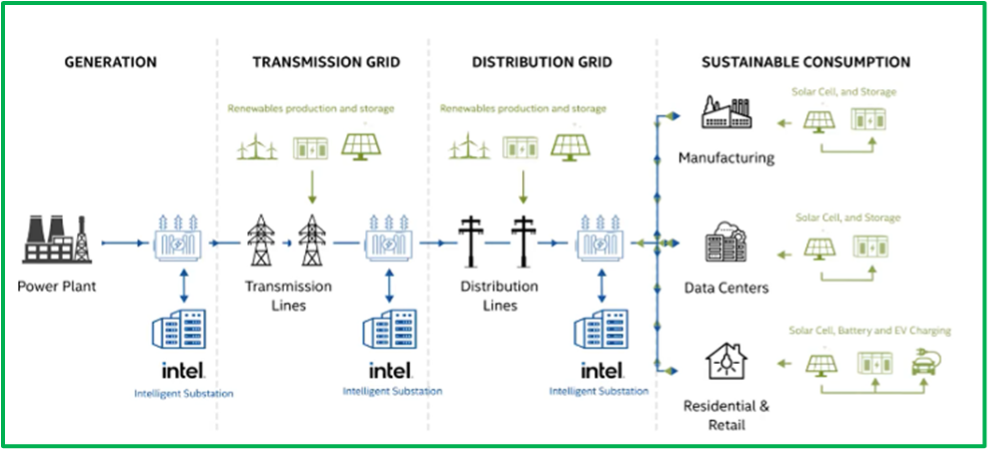
Source: https://www.weforum.org/agenda/2022/12/the-future-of-smart-energy-is-systemic-open-and-collaborative
As the weather continues to worsen, smart grids are more resilient and better able to meet demand peaks due mainly to their distributed nature. Due to their communication capabilities and distributed network, they can allocate power over multiple paths, thus bypassing downed lines or equipment that has historically caused major outages.
Since these renewable energy sources are intermittent, the energy source is positioned in many distributed locations, closer to the consumers. In contrast to the traditional one-way flow of electricity, smart grids use smart sensors and have omnidirectional capability. This enables better power management across the grid and more easily allows consumers to manage their electricity use by running certain devices at certain times and even being the energy producer.
Another major benefit of smart grids is security. The communication networks within smart grids are equipped with encryption and other security measures, such as authentication protocols and access controls. They segment the grids, which can limit the impact of a security breach. They monitor their network for security incidents and regularly update their software and security protocols. While no one is immune to security risks, this type of smart distributed network is far more secure than the traditional grid.
PLM’s Role in a Smart Grid
Many power plants were designed over 40 years ago, long before PLM was popular, and therefore are largely not digital and expensive to operate and maintain. The same is true of the existing grid infrastructure. Today, solar, wind, and the smart, connected assets used in a smart grid are designed using PLM. Smart grids and other smart devices use not only PLM but often IoT with greater use of digital twins and digital threads and will use AI. The grid is transforming from a one-way flow from power plant to consumer to a distributed collection of smart, connected assets that must be monitored, serviced, and managed throughout their lifecycle. CIMdata believes this improves the operational efficiency of the energy companies providing electricity to the consumer. The smart grid is also lowering the cost to consumers while providing more resiliency. It also improves the operational efficiency of the OEMs producing the energy products (e.g., wind turbines) and operating grid infrastructure.
While there is an alarming backlog of renewable energy projects today, expect major investment in smart grids over the next decade. We must lay the foundation to enable the transition to a future decarbonized world.
Thank you again, and please reach out to me with any questions.
Mark
PS: Check out my PLM & Green Energy page at PLM Green Global Alliance!