PDF
PDF
How manufacturers can evolve beyond PDM using use-case-driven PLM capabilities
Takeaways
- PLM modernization must align with operational reality, not force disruptive transformation.
- A secure, connected system of record is foundational to digital continuity. Manufacturers require governed, accessible product data with strong security and controlled access across the lifecycle.
- PLM value is increasingly delivered through modular, use-case-driven capabilities. Web-based modules, such as Engineering Change Management, enable rapid deployment and faster time to value without requiring a full platform replacement.
- Hybrid architectures provide a practical bridge between legacy environments and modern PLM capabilities. They allow organizations to maintain CAD-centric operations while introducing web browser-based and SaaS capabilities where they deliver the most value.
- AI in PLM must focus on practical productivity gains, not abstract intelligence. Looking ahead, capabilities such as semantic search and automated metadata extraction will further improve data access, quality, and efficiency within existing workflows. PRO.FILE’s hybrid architecture enables incremental evolution, preserving existing investments while expanding lifecycle capabilities over time.
Introduction: Challenges Industry Faces
Manufacturers are facing increasing pressure from rising product complexity, variant proliferation, and expanding regulatory requirements. These forces are placing significant strain on engineering and lifecycle processes, particularly in organizations that continue to rely on PDM and document management systems that control files but do not manage lifecycle processes.[1]
While these systems effectively manage engineering data, they limit visibility beyond engineering, restricting access for downstream functions such as manufacturing, supply chain, and service. As a result, organizations struggle to extend from document-centric environments into structured PLM capabilities, including engineering change management and lifecycle governance.
Traditional PLM solutions are often perceived as high cost, require long implementation duration, and operationally disruptive—particularly for small- to mid-sized manufacturers. These organizations require approaches that deliver value in weeks, not years, and that align with existing operational constraints.
Fragmented integration between CAD, PLM, and ERP systems further compounds these challenges. Inconsistent product structures, duplicate data, and manual synchronization introduce errors and inefficiencies. Engineering change processes are frequently unstructured or inconsistently applied, leading to information loss and increased compliance risk.
Accessibility is another major barrier. Product data often remains locked in desktop-based tools, limiting collaboration across distributed teams and preventing non-engineering users from effectively participating in lifecycle processes. At the same time, organizations face growing requirements for secure access, authentication, and governance of product data to protect intellectual property and meet regulatory expectations.
Finally, accumulated technical debt, system complexity, and integration challenges—particularly in highly configurable CAD-centric environments—continue to slow PLM adoption. These factors reinforce the need for a pragmatic, incremental approach to PLM that delivers measurable value quickly while minimizing disruption.
Extending PDM into PLM Through a Connected Architecture
Establish a Secure, Governed System of Record
Extending PDM into PLM begins with establishing a secure, governed system of record that provides centralized, trusted product data with full traceability and lifecycle context. This system must go beyond document storage to ensure that all required product information is structured, connected, and accessible across the enterprise.
Security is embedded as a core capability, including authentication, authorization, and data integrity controls. This foundation enables compliance, auditability, and controlled access, ensuring that product data can be securely shared and reused across engineering and downstream processes.
Connect Engineering, ERP, and Enterprise Systems
PLM must serve as a bridge between engineering and enterprise systems, enabling consistent product structures and metadata across CAD, PLM, ERP, and other enterprise environments. Modern API-based integration frameworks reduce manual data transfer and improve scalability while supporting integration with multiple enterprise systems.
This connectivity improves alignment between engineering change processes and downstream execution, ensuring that manufacturing, supply chain, and service operations are working from consistent, accurate product data.
Adopt Hybrid Architecture for Incremental Modernization
Hybrid architecture provides a practical approach to modernization by supporting on-premises environments required for CAD and engineering workflows while introducing web browser-based and SaaS extensions where they deliver the most value.
Importantly, on-premises deployment is not a transitional state but a deliberate strategic choice. It provides manufacturers with data sovereignty, intellectual property protection, and control over sensitive engineering data—critical advantages in regulated and security-conscious industries. A hybrid architecture enables organizations to modernize incrementally without disrupting existing infrastructure.
Deliver PLM Through Modular Capabilities
PLM capabilities are increasingly delivered through modular, use-case-driven implementations. Organizations can deploy targeted functionality such as engineering change management or ERP integration to address specific business needs.
This incremental approach reduces complexity, accelerates deployment, and delivers measurable value quickly compared to traditional enterprise PLM programs.
Improve Accessibility and Usability of Product Data
Web browser-based access enables location-independent interaction with product data, allowing distributed teams and non-engineering users to engage with lifecycle processes. High-performance search capabilities improve data retrieval speed, returning large result sets in near real time, and significantly enhancing user productivity. This reduces dependency on desktop tools and improves accessibility across the organization.
Apply AI to Enhance Productivity and Data Quality
AI capabilities in PLM are most effective when applied to practical use cases that enhance productivity and improve data quality. Semantic search enables contextual understanding and more accurate results, while automated metadata extraction reduces manual effort in classification and document management.
These AI-powered capabilities improve consistency, support better decision-making, and enhance the usability of product data within existing workflows.
PRO.FILE
Transition from On-Premises PDM to PLM
PRO.FILE has traditionally been deployed as an on-premises PDM and document management solution tightly integrated with CAD environments. Its current strategy focuses on extending into PLM by introducing structured lifecycle capabilities, including engineering change management, with additional capabilities such as requirements management and asset management planned on their current roadmap.
This evolution is delivered through extensions of the existing platform rather than replacement, preserving prior investments while enabling a transition from document control to process-driven lifecycle management across engineering and downstream domains. Figure 1 illustrates how PRO.FILE acts as the system of record for connecting engineering, enterprise systems, and downstream processes within a digital thread.
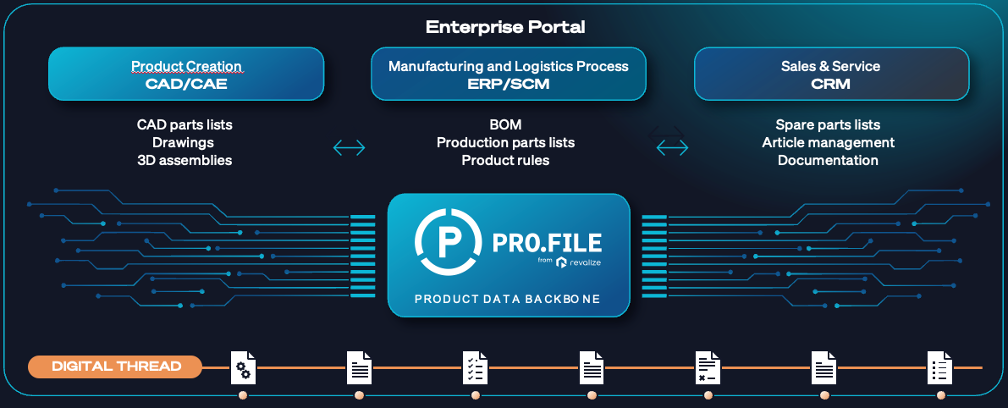
Figure 1—PRO.FILE Product Data Backbone Connecting CAD. ERP, and Enterprise Systems
(Courtesy of Revalize)
Secure and Connected System of Record
PRO.FILE provides a secure, trusted system of record for product data, emphasizing data integrity, governance, and lifecycle traceability. It connects people, processes, and enterprise systems across the lifecycle, supporting compliance, auditability, and secure collaboration for both internal and external stakeholders.
Hybrid PLM Architecture
PRO.FILE’s architecture is based on a hybrid model that maintains a single-tenant, on-premises or hosted core environment for CAD integration, while introducing web browser-based, cloud-hosted SaaS modules connected to that core.
This approach allows organizations to modernize at their own pace without sacrificing control or continuity. The hybrid model reflects a deliberate strategic choice to maintain data sovereignty and IP protection on-premises, while extending capabilities through secure cloud-connected modules—without requiring full system migration.
Modernized Integration Framework
PRO.FILE 10.5 introduces a modern ERP integration framework that enhances existing integration approaches while maintaining backward compatibility. API-based connectivity supports integration with multiple enterprise systems, reducing complexity and improving interoperability. This modernization improves alignment between PLM and ERP processes, enabling more consistent product structures and reducing manual reconciliation efforts.
Differentiating Capabilities
PRO.FILE offers several differentiating capabilities that address key barriers to PLM adoption. The EASY.CON no-code configuration environment allows organizations to adapt workflows without requiring developer resources or solution provider involvement, reducing total cost of ownership and eliminating dependency on external implementation services.
Native out-of-the-box integrations with all major CAD systems enables manufacturers to retain existing design tool investments while avoiding solution provider lock-in. In addition, a structured implementation methodology with defined work packages, fixed timelines, and transparent costs reduces the financial and operational risk typically associated with PLM deployments.
Web Browser-Based Access and Search
PRO.FILE provides web browser-based access and high-performance search capabilities that enable users to retrieve large volumes of data quickly and efficiently. This supports location-independent access, reduces reliance on desktop clients, and improves productivity for both engineering and non-engineering users.
Engineering Change Management (ECM)
The Engineering Change Management module provides structured control of change processes, including change requests, orders, and communication workflows, with full traceability and documentation.
Delivered as a web browser-based module available on both cloud and on-premises deployments, ECM enables rapid deployment in minutes to hours rather than days or weeks. Importantly, customer data remains within the customer’s own database even in cloud deployments, ensuring data sovereignty. The module directly addresses unstructured and inconsistent change processes, reducing information loss and improving compliance.
Expanded PLM Capabilities (Roadmap)
PRO.FILE’s roadmap expands PLM capabilities through a phased approach. Near-term enhancements include AI-powered semantic search with contextual understanding and improved relevance, as well as enhanced CAD integrations that improve synchronization performance and reduce errors. Planned capabilities include requirements management, enabling traceability from definition through validation; asset management, including service Bill of Materials (SBOMs) and integration with service and IoT environments; and a web browser-based collaboration platform supporting secure interaction across internal and external stakeholders.
AI-driven automatic metadata extraction will further improve data quality by automating classification, enforcing naming conventions, and reducing manual effort, enhancing both searchability and consistency of product data.
CIMdata looks forward to seeing PRO.FILE’s progress as they expand their offering with these capabilities.
Scaling PRO.FILE Globally
PRO.FILE is expanding beyond its traditional European base into North America as part of a broader global growth strategy. Cre8tive serves as a North American implementation and services partner, supporting deployment, integration, and customer adoption to accelerate market expansion. For more information, please see the Cre8tive website.
Conclusion
Manufacturers must adopt modernization strategies that align with operational realities rather than forcing disruptive transformation. Establishing a secure, connected system of record is essential to ensuring governed, accessible product data across the lifecycle.
Delivering PLM through modular, use-case-driven capabilities enables faster time to value, allowing organizations to deploy targeted functionality such as engineering change management without requiring full platform replacement. Hybrid architectures provide a practical bridge between legacy environments and modern PLM capabilities, enabling incremental adoption while preserving existing investments.
AI will play an increasing role in improving productivity and data quality, particularly through capabilities such as semantic search and automated metadata extraction that enhance usability within existing workflows.
PRO.FILE enables this approach through its hybrid architecture, supporting incremental evolution while maintaining control, continuity, and data sovereignty. Its continued global expansion, supported by partners such as Cre8tive, will be critical to scaling adoption.
CIMdata recommends that small- to mid-sized manufacturers evaluate PRO.FILE as a pragmatic and low-risk path to modernizing their product lifecycle capabilities. To learn more about PRO.FILE see their website.