PDF
PDF
The Frontier of B-Rep, Convergent, Implicit modeling, and more
Takeaways
- The 2026 Siemens PLM Components conference signaled a distinct industry shift focused heavily on integrating Artificial Intelligence (AI) and expanding geometry representation paradigms. The central themes revolved around the collision and convergence of traditional boundary representation (B-rep) with facet geometry and implicit modeling.
- While implicit modeling leverages modern GPU parallel processing efficiently, converting it back to traditional B-rep for manufacturing creates a major interoperability challenge. To solve this, Siemens is expanding Parasolid’s Convergent Modeling framework to natively support and mix implicit geometry seamlessly without forcing full format conversions.
- Siemens is aggressively updating its battle-tested Parasolid and D-Cubed components to support modern developer workflows with new Python bindings and forthcoming WebAssembly deployment. Additionally, Parasolid is expanding its scope to support “mixed-scale” large assemblies, such as modeling a microchip within the context of an entire city.
- The AI Industry panel noted that implementing AI requires overcoming hurdles like low-quality training data, advising developers to focus on specific, high-value differentiators trained on validated data.
Introduction
Following up on the highly successful 2024 event in Boston, CIMdata had the pleasure of attending the 2026 Siemens PLM Components Innovation Conference, held at the historic Downing College at the University of Cambridge UK, on April 28 and 29, 2026.[1] The event was at capacity with more than 100 attendees from about 50 leading CAD, CAM, CAE, and AEC organizations and featured 27 speakers.
While the 2024 conference focused heavily on widespread interoperability and market penetration, the 2026 event clearly signaled a phase change in the industry. The central themes this year were Artificial Intelligence (AI) and the broadening paradigms of geometry representation—specifically the collision and convergence of traditional boundary representation (B-rep) with faceted geometry and implicit modeling.
Mr. Bob Haubrock, SVP of Product Engineering Software at Siemens Digital Industry Software, opened the conference by highlighting three Siemens priorities: openness, innovation, and efficiency. Openness remains a defining principle of the Parasolid and PLM Components business. For decades, Siemens has licensed core technologies including Parasolid, D-Cubed, and JT Open to major competitors such as Dassault Systèmes and PTC. CIMdata continues to recommend this licensing and support model to companies evaluating technology partnerships.
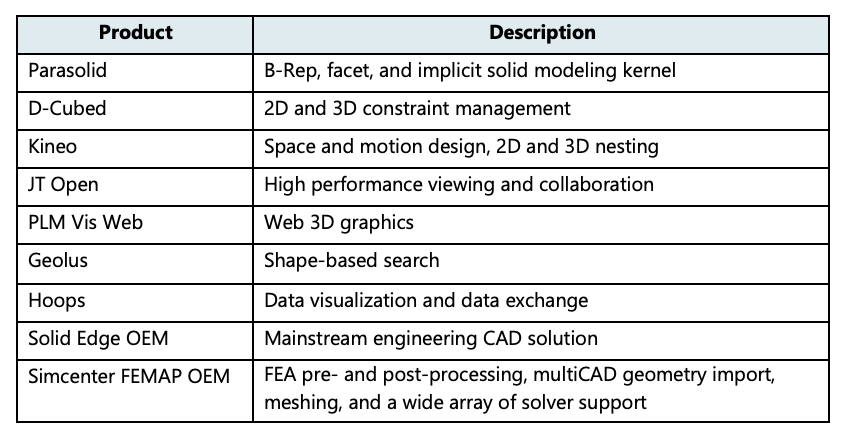
Mr. Haubrock also stressed the efficiency of using proven, battle-tested software components in demanding applications. Siemens’ long-standing and expanding customer base reflects the trust it has built over time. The products in the PLM Components portfolio are listed in the table below.
Siemens PLM Components Updates
Siemens executives and product teams provided updates across their core component portfolio, proving that legacy reliability is successfully merging with next-generation architecture:
- Parasolid—Mr. Phil Nanson, Director of Parasolid Components, detailed the kernel’s expanding scope. Key updates include support for “mixed-scale” large assemblies (e.g., modeling a microchip in the context of a building), new Python bindings, and forthcoming WebAssembly support. Importantly, Parasolid is expanding its convergent modeling capabilities to handle implicit geometry alongside traditional B-reps and faceted data.
- D-Cubed—Mr. Peter Knight, Manager of D-Cubed Components, the constraint-solving portfolio introduced new features such as inequalities in 2D DCM, intersection finding in PGM, and advanced spline support in 3D DCM. Future roadmaps for D-Cubed also target WebAssembly deployment and Python wrappers.
- Kineo—Mr. Ambroise Confetti, Product Owner for Kineo, presented on Kineo’s collision-free path planning and flexible cable routing, important solutions for robotics applications. He gave a brief update on 2D and 3D nesting showing applications in subtractive and additive manufacturing respectively.
- Solid Edge OEM—Mr. Dan Staples, Vice President, Mainstream Engineering, celebrated the 30th anniversary of Solid Edge, highlighting its debranded OEM UI and drafting capabilities powered by Parasolid and D-Cubed. He stressed the value of using OEM versions of both Solid Edge and Femap to speed time to market. In a later presentation, Mr. Chun Qing Li, CEO of Kreodx, explained that his company uses Solid Edge OEM as the CAD engine for its AEC lifecycle management product. He added that the product’s maturity and licensing terms let his team focus on the capabilities their customers need without having to recreate existing technology.
The AI and Implicit Geometry Revolutions
 A distinct highlight of the 2026 conference was the deep analysis of how AI and implicit modeling are fundamentally reworking the engineering software stack.
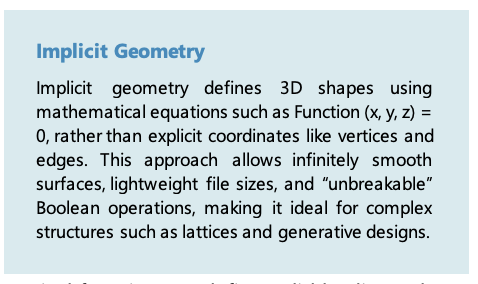
The industry is experiencing a broadening of geometry representation paradigms, with implicit modeling emerging as a crucial technology alongside traditional boundary representation models. During the conference, Mr. George Allen, Technical Fellow at nTop, detailed how implicit modeling utilizes continuous mathematical functions to define solid bodies rather than explicit vertices, edges, and faces. This mathematical approach is inherently robust for generating highly complex topologies like branching structures and intricate lattices. Furthermore, while conventional boundary representation algorithms are heterogeneous and suffer from thread divergence on modern graphic processing units, implicit models use homogeneous mathematics that are highly friendly to parallel processing. However, Mr. Allen emphasized that converting implicit bodies into boundary representations required by many downstream manufacturing and drafting applications remains a significant challenge—often considered to be a necessary evil that can result in distorted surfaces and reliability issues.
To address this interoperability challenge, Siemens is expanding its foundational kernel capabilities rather than forcing users into complete format conversions. Mr. Nanson highlighted how Parasolid is extending its Convergent Modeling framework to natively support implicit geometry. By treating implicit surfaces and lattices with the same unified approach previously applied to faceted and classic boundary representation data, Parasolid will ultimately allow applications to mix these formats seamlessly. This foundational support enables engineering software to perform operations directly on cellular bodies containing implicit pattern lattices, ensuring that downstream inquiries like slicing or mass property calculations can occur without sacrificing accuracy or design intent. Currently lattices and transient objects leverage the new technology, and implicit objects will become persistent in future releases.
This expanded kernel capability is actively enabling independent software vendors to develop novel, intelligent workflows. Mr. Paul Chastell, Technical Vice President at PTC Onshape, demonstrated a compelling integration of Parasolid, implicit geometry, and artificial intelligence. Recognizing that large language models excel at writing code but struggle with raw geometric mathematics, Onshape utilizes a Model Context Protocol server to evaluate AI-generated FeatureScript code snippets. This architecture acts as a safeguard to eliminate hallucinations while generating complex implicit surfaces. The resulting workflow produces convergent parts where boundary representation features and AI generated implicit geometries coexist, demonstrating a practical pathway for engineers to leverage algorithmic design without losing the editable, parametric features required for final production.
A panel discussion on geometry representation facilitated by Ms. Monica Schnitger, Industry Analyst and CEO Schnitger Corp, further illuminated the industry’s complex transition toward these new mathematical models. Panelists—including Mr. Allen and Mr. Nanson—highlighted the tension between legacy systems and modern computational capabilities. While traditional boundary representations are viewed as a natural extension of 1970s CAD, engineers still heavily rely on these analytic shapes due to established workflows and an inherent “trust issue” with new, unfamiliar formats. However, the panel reached a strong consensus that next-generation CAD will inevitably be based on implicit modeling to fully leverage modern GPU computation and algorithm-driven design.
To bridge this “convergence gap” between B-reps and implicit models, the panel cautioned against a one-size-fits-all approach. Mr. Nanson advised developers to “never use one tool for everything,” but instead to use the specific geometric representation that is most appropriate for the task at hand, whether that involves calculating assembly mates, defining hard edges, or generating complex additive lattices. Ultimately, the panel noted that end-users don’t care about the underlying mathematics—whether the system uses mixed meshes, boundary representations, or implicit geometry—if the software delivers reliable and editable results. This pragmatic reality reinforces the necessity of deferring discretization for as long as possible and utilizing a unified kernel that can seamlessly juggle multiple geometry types.
Ms. Schnitger also led a panel discussion on AI. During the AI panel discussion, industry experts addressed the practical realities and implementation challenges of integrating artificial intelligence into engineering workflows. Panelists noted that while AI offers clear opportunities for multi-domain optimization and automating repetitive tasks, the industry still faces significant hurdles, particularly regarding low-quality, undifferentiated training data and the complexities of interpreting design intent from legacy CAD models. To successfully navigate these limitations, the panel advised developers to start small by focusing on specific, high-value differentiators such as weight reduction, iterating carefully, and ensuring models are trained exclusively on officially released company data. Furthermore, the conversation underscored the critical need for human-centric, self-service software design, reinforcing that AI must be framed to augment user workflows rather than acting as an autonomous black box. Panelists also cautioned about ongoing risks associated with explainability and liability, advising organizations to establish robust evaluation methodologies to safely manage continuous underlying LLM upgrades.
Customer and Partner Presentations
Like 2024, the true power of the conference was showcased through Siemens’ partners and customers, who demonstrated how they are leveraging Siemens’ components to build the future of product modeling tools. Red Bull Racing stood out as a Siemens industrial customer that develops custom tools using JT Open to support their CFD process. The other customers shown in the table primarily demonstrating their products and how AI is being incorporated and leveraged.
Customers Who Presented About Their Use of Siemens PLM Components
| Altair (Siemens) | Hexagon | Onshape (PTC) |
| AMC Bridge | InfinitForm | Quicksurface |
| Cenit | Kreodx | Synera |
| Cimatron (Sandvik) | Materialise | Tech Soft 3D |
| Encube | nTop | Toolpath.com |
Conclusion
The 2026 Siemens PLM Components Innovation Conference clearly demonstrated that the foundational tools of engineering software are adapting to meet the increased capabilities of modern computational hardware and artificial intelligence. By expanding the Parasolid kernel to natively support implicit geometry alongside traditional boundary representations, Siemens is providing a highly pragmatic solution to one of industry’s most pressing interoperability challenges. This convergent approach allows independent software vendors to build intelligent, algorithm-driven applications without sacrificing the exact analytic geometry strictly required for downstream manufacturing and drafting processes. Furthermore, the commitment to modern architectures, such as WebAssembly and Python wrappers, ensures that these established components remain highly applicable for cloud-native software and next-generation AI workflows.
For companies building the next generation of CAD, CAM, and CAE software, attempting to build a proprietary geometric engine from scratch introduces significant risk and delays time to market. CIMdata recommends that both established enterprise vendors and emerging startups evaluate Siemens PLM Components when developing or modernizing their engineering tools. Leveraging these proven, mathematically robust components allows organizations to focus their development resources on unique workflow automation and industry-specific capabilities, rather than spending years resolving fundamental geometric infrastructure and translation issues.