How Nora IPLM uses a connected digital thread, cloud-native architecture, and AI to simplify product lifecycle management
Takeaways
- Manufacturers need increasingly sophisticated lifecycle capabilities, but SMBs face many of the same competitive pressures as large enterprises with significantly fewer engineering, IT, and administrative resources, more constrained budgets, and limited tolerance for implementation complexity.
- The objective of a modern PLM solution should be to reduce unnecessary user and implementation complexity without weakening configuration control, change discipline, traceability, or the product definition.
- A modern innovative PLM foundation must connect ideas, requirements, items, CAD data, EBOMs and MBOMs, configurations, changes, documents, projects, suppliers, and downstream enterprise applications as a governed digital thread.
- AI increases the importance of connected contextualized product data. Useful lifecycle intelligence depends on trustworthy object relationships and traceability.
- Nora IPLM takes a modern, global approach based on cloud-native delivery, a relationship-rich product model, process and role-oriented cockpits, open integration, and embedded AI capabilities intended to improve analysis and decision support.
Introduction: Modern PLM Capability Without the Complexity
Small and mid-size manufacturers operate in an environment of growing product complexity. They face many of the same configuration, change, quality, supplier, and time-to-market challenges as large enterprises—but typically at lower volumes, with fewer dedicated IT and PLM resources, and with less tolerance for extended implementation timelines and high total cost of ownership.[1]
Product information in these organizations remains fragmented across CAD systems, spreadsheets, documents, email, shared drives, ERP, and other business systems. This fragmentation creates version conflicts, uncertain bill-of-materials status, slow change execution, duplicate data entry, limited supply chain visibility, and weak lifecycle traceability. Engineers and other stakeholders spend time searching for the right version of the right information rather than creating value.
Traditional PLM platforms provide needed configuration control, change management, workflow, and traceability. However, lengthy deployments, specialized administration, extensive customization, and complex user experiences have historically created barriers to adoption for smaller manufacturers. The implementation burden and ongoing administrative overhead often exceed what SMB organizations can sustain.
The challenge is not to eliminate PLM capability. It is to shield users from unnecessary complexity while preserving lifecycle governance and control. Modern PLM should retain sophisticated product relationships, governance, configuration, and traceability while simplifying how users access information and execute processes. Artificial intelligence increases the urgency of this challenge: AI increases the need for connected, contextualized, and governed product information to support reliable analysis and decision-making. Organizations that cannot establish a disciplined product information foundation will find AI initiatives limited to isolated experimentation rather than providing measurable business value at scale.
CIMdata’s View: A Modern Foundation for the Product Lifecycle
CIMdata defines a modern PLM foundation around several interconnected capabilities that together reduce implementation and user complexity without compromising lifecycle discipline.
AI-Native Digital Thread
Product context and traceable data relationships provide the foundation required for trustworthy AI-assisted lifecycle decisions. AI models that operate without access to authoritative product structures, configurations, and change histories generate outputs that are difficult to validate and unreliable as a basis for engineering decisions concerning product information. The digital thread is not simply a data integration challenge—it is the governance foundation that determines whether AI agents can be trusted at scale.
Connected Product Definition
A modern PLM platform must govern requirements, items, documents, designs, EBOMs and MBOMs, configurations, changes, projects, issues, suppliers, and related lifecycle information within a common product context. Connection within a single governed environment eliminates the fragmentation that undermines data quality and traceability while enabling more reliable data analysis and agentic automation.
Digital Thread
Traceable relationships must be maintained across disciplines and lifecycle stages to expose upstream and downstream dependencies. Without this traceability, the impact of a change in one domain remains invisible to downstream functions, increasing risk and rework.
Configuration and Change Management
Configuration and change must be managed within the product context—tracking what changed, why it changed, affected configurations, approvals, downstream impacts, and implementation status. Separating change management from the product definition it affects creates the same fragmentation that PLM is designed to eliminate.
Engineering-to-Manufacturing Continuity
Connecting engineering and manufacturing product structures reduces manual recreation of information and supports increasingly configured products. As product portfolios expand the number of variants and options, manual handoff between engineering BOM and manufacturing BOM becomes a significant source of error, delay, and cost.
Open Architecture and Role-Based Experience
Integration with CAD, ERP, ALM, project management, MES, SLM, EAM, and supplier environments is essential to avoid creating another information silo. Equally important is presenting information through role-based experiences that expose relevant lifecycle data, actions, status, and exceptions without requiring every participant to understand the full PLM information model.
Deployment and Administration
Deployment and administration complexity has historically been one of the primary barriers to PLM adoption in SMB organizations. Infrastructure, custom code, upgrade burden, and dependence on specialized PLM resources must be minimized while supporting required business-process configuration through low-code and no-code tools.
Lifecycle Intelligence
AI applied to governed product information enables search, summarization, relationship analysis, change-impact assessment, risk identification, and decision support. Lifecycle intelligence depends on the quality and connectivity of the product data foundation—agentic AI amplifies what is already there rather than compensating for what is missing.
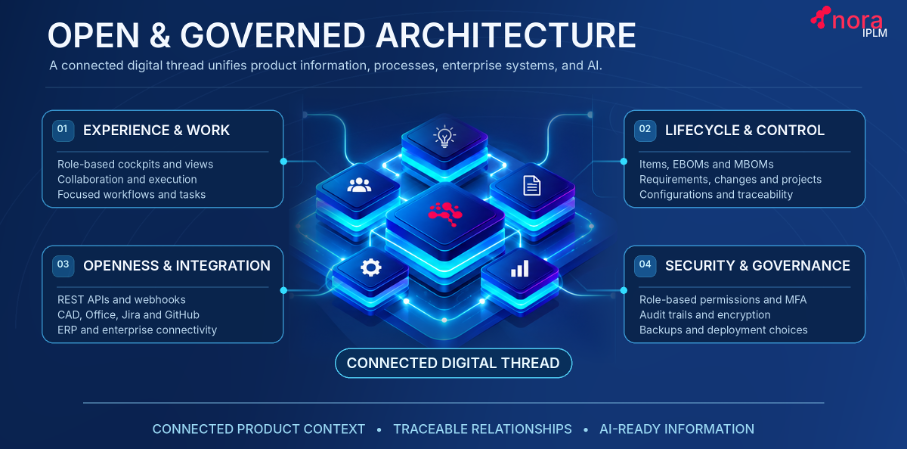
Figure 1: Nora IPLM’s Open and Governed Platform Architecture
(Courtesy of Cerebital)
Nora IPLM: Rethinking How PLM Is Delivered
About Nora IPLM
Developed by Cerebital, Nora IPLM (Innovation and Product Lifecycle Management) is an emerging PLM platform supported by a global team distributed across the United States, United Kingdom, Turkey, and India. Nora IPLM focuses on SMB and midsize discrete manufacturers across industrial equipment, automotive, manufacturing, and high-tech sectors. The company offers transparent, subscription-based pricing available via its website and positions Nora IPLM as a cloud-native alternative to traditional PLM platforms that have historically been difficult for smaller manufacturers to deploy and sustain.
As an emerging provider, Nora brings a modern architectural perspective without the legacy constraints that burden established PLM platforms. Prospective customers should validate product maturity, required integrations, implementation support, and roadmap alignment for their intended scope.
Architecture and Solutions
Nora IPLM combines items, EBOM/MBOM, requirements, documents, lifecycle and revision management, change, workflows, projects, configuration, collaboration, analytics, and AI within a cloud-native platform. The platform is built on a relationship-based product model with more than 50 object types and over 100 defined relationship types connecting requirements, items, workflows, change tasks, configurations, manufacturing assemblies, and other lifecycle objects. This foundation provides flexibility and extensibility for traceability, digital-thread navigation, and AI analysis.
The unified digital thread within Nora IPLM allows users to navigate relationships among product information rather than searching disconnected applications and records. Product configurator capabilities address models, features, options, effectivities, and occurrences, with MBOM capabilities being expanded for manufacturing use cases.
Configurable object relationships, reusable workflow templates, and composable role-based views allow organizations to adapt the system to their processes. This flexibility is intended to limit specialized development and ongoing administration while retaining lifecycle governance.
User Experience and Cockpit Design
Nora IPLM delivers a modern, configurable user experience through dashboards, widgets, and insights that bring relevant product data, analytics, and actions into focused views. Composable cockpits assemble role- and process-specific combinations of product data, relationships, workflows, analytics, and actions into focused workspaces, simplifying complex PLM activities without sacrificing underlying lifecycle capabilities.
The Change Cockpit connects change requests, orders, tasks, affected information, and related product objects to improve visibility into change impact and execution. Role- and process-oriented cockpits for change, configuration, systems engineering, and program and project management are designed to expose relevant lifecycle information without exposing unnecessary PLM complexity to users who do not need it.
Nora IPLM also connects process execution to product context through reusable workflow templates, assigned tasks, parallel execution, branch and merge policies, and linked deliverables. Teams can follow status, responsibilities, and outcomes while navigating the associated product, program, project, and change information. This brings process control and lifecycle traceability together in a focused working environment.
AI Capabilities: Prima
Prima combines Nora IPLM’s embedded AI assistant with domain-specific agents to support lifecycle analysis, decision support, and in-context actions within the PLM environment. Nora IPLM has demonstrated relationship-based AI-driven impact analysis across items, issues, suppliers, drawings, and other objects to evaluate change impacts and alternatives, including cost and weight trade-offs. Prima is designed to expand toward more autonomous and specialized agentic AI-driven workflows across the product lifecycle.
AI governance is addressed through an opt-in model, with customer data isolation and a choice of supported large language models, including OpenAI and Google Gemini. This gives organizations greater control over how AI is applied to proprietary product and engineering information. Nora IPLM’s connected digital thread provides the foundation for AI-enabled analysis across CAD, PLM, and manufacturing domains—a foundation that is essential for AI outputs to be trustworthy and actionable in engineering environments.
Integration and Openness
Live integrations include CAD, Microsoft Office, Jira, GitHub, APIs, and webhooks, with SAP, Oracle NetSuite, and custom ERP integrations available on request. Nora IPLM’s MCP server provides an additional mechanism for connecting governed PLM information with compatible applications and AI services, positioning the platform for an emerging ecosystem of AI-enabled tools that leverage governed product context.
Conclusion
The PLM market opportunity is not simply to reproduce established PLM functionality on newer infrastructure, but to rethink connectivity, user interaction, deployment, and how product context is used by AI. Manufacturers should not be forced to trade PLM discipline and lifecycle control for simplicity. Modern platforms must deliver both.
Nora IPLM’s combination of connected lifecycle data, cloud-native delivery, role-oriented experiences, open integration, and AI-enabled analysis represents a credible approach to reducing PLM complexity without sacrificing lifecycle discipline. The platform is built on a modern architecture that incorporates AI from inception, which is architecturally significant. CIMdata is impressed with Nora IPLM’s capabilities. Prospective customers should validate current product maturity, required integrations, implementation support resources, and roadmap alignment for their intended deployment scope.
CIMdata recommends that small and midsize discrete manufacturers worldwide evaluating modern PLM alternatives include Nora IPLM in their assessment when rapid deployment, usability, openness, and AI-enabled lifecycle intelligence are important criteria. Pricing is available at www.noraplm.com/product/pricing/.