PDF
PDF
Design Chain Issues
Collaborative product development supports shared decision making through improved communications across the extended enterprise, with the goals of improving change processes, broader use of design information in decision processes, reducing product time- to-market, removing costs, improving quality, and supporting product innovation.
Change is constant and to continue to improve their competitive position, companies which once designed, manufactured, and serviced their own products are now dramatically reorganizing the way they do business. Manufacturing companies face the challenge of extending their current capabilities outside the enterprise to include customers, suppliers, sub-contractors, and even competitors. Outsourcing functions such as design, manufacturing, and services have provided many companies with cost advantages. However, to do this, well-established communication channels, control procedures, and management practices, progressively built up over time, must change to take advantage of new processes, organizational structures, and enabling technologies.
Another issue is that geographically-distributed companies potentially have a competitive edge, as their workforce can operate across different territorial regions and time zones, taking advantage of preferential labor and tax rates with the opportunity to benefit from extended working hours. Some organizations have restructured to provide 24-hour design and manufacturing capabilities. The problem is how to provide effective communications with efficient product data exchange across these extended enterprises. In a distributed environment, communication to resolve product development issues becomes a problem as employees must use a combination of different methods including telephone, faxes, file transfers, and e-mail discussions. When these communication methods fail to convey information accurately or clearly, as is often the case, it becomes necessary for staff to travel to a common meeting point in order to resolve outstanding issues. In the distributed enterprise, traveling to meetings is both costly and disruptive.
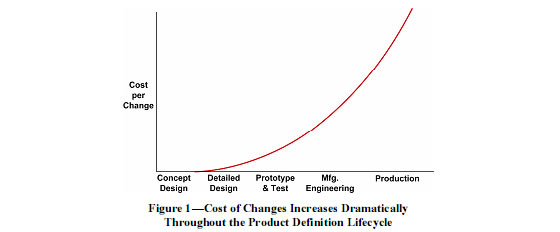
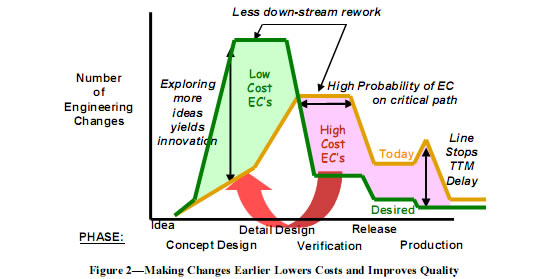
A major use of meetings in product definition is to review and approve design changes. When decisions are delayed, changes have to be resolved later in the process, leading to higher costs and cascading design errors resulting from the use of incorrect data. Additionally, while the rate of change during design can be high, the costs of each change are usually low, whereas problems found downstream in manufacturing cost significantly more to implement. Effective early communication throughout the entire product definition process is essential in reducing late costly design changes. See Figures 1 and 2.
The primary physical definition of manufactured products is typically created as 3D CAD models. However, most people who need to make decisions about product designs do not have access to this primary, information-rich product definition information because they don’t have tools that allow them to view and evaluate 3D data. Forced to rely on 2D drawings and pictures, their ability to fully comprehend the design is significantly reduced. Collaborative viewing tools that are much easier to use than CAD systems unlock the value of product designs.
These issues and many more point to the need for a streamlined way for people to evaluate designs and participate in decision making with their colleagues and outside partners in the product development process. This can lead to improvements in time and cost savings for enterprises.
Methods of working collaboratively have existed as long as humans have joined together to accomplish tasks that could be done better by a team than an individual. The ways in which people collaborate are always restricted by the techniques that are available for flexible and timely sharing of information, feedback, and actions taken on shared data. In the past, business support technologies have allowed real-time, synchronous collaboration only when people could work face-to-face or, in some simple endeavors, by telephone or audiovisual conferences. Many current technologies support asynchronous, serial collaboration by managing data and information access.
Collaboration Solutions
Collaboration tools are designed to solve the limitations of conventional communication methods by providing an environment where team members participate and share information in real-time. New collaboration tools support working on a number of different formats of information including 3D models, assemblies, components, BOMs, drawings, documents, test reports, etc. In most cases, the data comes from a number of different applications such as CAD, word processors, PDM, and other systems.
A key difference in collaboration products is the approach taken by each to provide data access. Many products adopt an asynchronous or serial approach in accessing data. Users working in an asynchronous manner carry out their assigned tasks and then forward the data to other people. This manner of working is serial in nature and only allows users to participate one at a time. Asynchronous communication among collaborators is normally carried out using telephone calls, file exchanges, and e-mail. Effective collaboration requires an information storage area from which product definition data can be shared with each user. This shared area is commonly referred to as a data vault. Users at remote sites are given access to the vault. Flow control and task execution is performed in an asynchronous way using workflow and project management tools. These tools allow data to be routed to users and progress to be monitored.
Synchronous or real-time collaboration tools enable users located at different locations to view, work with 3D data and carry out interactive communications with each other in real- time. The more advanced products not only support the ability to view, rotate, add notes and annotation pointers, but also offer functionality to change the 3D design model data. This provides online meetings that emulate having all participants in the same room, at the same time, looking at the same data on one screen.
These computer-based technologies allow complex information to be shared and worked upon by dispersed teams of people. It is impossible to collaborate on information that cannot be found and collaborating on out-of-date or incorrect data can lead to bad decisions, so data management capabilities are necessary. PDM in particular is used to organize and provide broad access to a company’s intellectual assets. However, simply organizing data better produces important, but limited value. The concept of Product Lifecycle Management (PLM) embraces the collaborative use of the managed information in an organization’s decision-making processes. New collaborative technologies now go beyond asynchronous data sharing to include real-time viewing, discussion, annotation, and modification of all kinds of product information including 3D design models, analysis results, manufacturing processes, documents of all kinds, audio, video, and many, many others—essentially all information required to make product definition decisions.
With visualization and markup tools, 3D models can be rotated, magnified, sectioned, checked for collisions, measured, and disassembled. Comprehension and understanding of ideas and concepts become clear and unambiguous. Collaboration with visualization tools allow many people to become involved in the product definition process at its earliest stages and throughout its life, people who, in the past, did not have access to 3D product information, without which it is difficult to make informed decisions about complex products. Customers and suppliers can be involved in the solution process, cooperating together in a shared working environment where new ideas and options can be investigated quickly and innovation is encouraged. Early and broad-based decision making and information sharing also helps avoid downstream problems. Another result of collaborative sharing of visual 3D data is to improve communication, not only within an enterprise, but with the extended enterprise of customers and suppliers.
Applying Collaboration to Product Design
The application of collaboration to product design can take two forms—sharing design data and designing during online meetings. Designers share data much as other people, as described above. In order to actually design online during a collaboration session requires either that one person runs a CAD seat connected to the session or that the CAD system is capable of operating within a meeting environment such that multiple users can be changing models at the same time and all updates are immediately available to everyone else in the meeting. The first of these is currently more common than the second since few CAD tools have collaboration capabilities built in that support the second option.
In any case, designers can realize very substantial time savings even by conducting change reviews and approvals through online collaboration sessions with visualization and digital mockup tools. Digital mockup tools allow designers to examine large assemblies, performing clash detection, measuring geometry, and examining assemblies to evaluate their validity. In this scenario, designers can take part in design change decisions and product brainstorming without having to be running a CAD system. They can even combine assemblies of designs from multiple CAD systems, breaking through the multi-CAD data incompatibility problem.