With the press of a button, a myriad of computerized technology activates beneath the inlaid wood and leather lined dashboard. The driver has just set in motion the results of thousands of hours of sophisticated engineering to execute a semi-automated parallel park. Programmed sensors; power steering; traction control and power, anti-lock brakes; computerized suspension; and voice instructions that indicate when to brake and when to shift; all smoothly interplay to deliver customer satisfaction—and park the car. Each system has been designed and manufactured by automotive specialists through the mechatronics interplay of mechanical, electric, and software control components.
The world’s automotive industry continues to experience intense business and technology pressures to deliver these technology improvements within an environment of tightening budgets and resources. The explosive growth in electronic, computerized systems in the typical automobile is undeniable and experts predict its growth will continue unabated. This mounting sophistication is countered by increasingly focused customer demands for regional, customized products based on market segmentation worldwide, including new emerging markets in India, China, and South America. This is no easy task to deliver, given the ongoing trend to execute the design and production of vehicles with reduced staffing and numerous specialists, often located around the globe.
Reduced time to delivery and reduced budgets permeate the competitive landscape calling for new solutions that support distributed product development with global collaboration between stakeholders.
Dassault Systèmes’ PLM 2.0 Solution
In response to these market requirements, Dassault Systèmes, long respected as an engineering focused company, delivers their answer for PLM 2.0, a Product Lifecycle Management “on-line for all” solution that allows all contributing individuals in the supply chain to work concurrently in real-time. Implemented as part of Dassault Systèmes’ Version 6 platform, individuals join in a fully-distributed product development environment via a simple web connection. Working together, the automotive team throughout the OEM and supply chain can make more informed decisions based on real-time sharing of the latest product information.
Dassault Systèmes delivers their web-enabled, global product development platform to foster the spirit of cooperation among contributors in the development of new vehicles. First, business tools are available to locate the proper resources that can deliver the needed product. Project leaders then have the capabilities to assign those resources with concise roles and target deliverables based on dependency schedules across all developers. Finally, the platform provides tracking and reporting tools to monitor the progress of the development effort. All these program management capabilities are woven into an environment of reduced risk and increased effectiveness.
In addition, the Version 6 platform with its 3D authoring and simulation applications allows users across the full supply chain to interact in a visual context with ongoing product changes. Each stakeholder can validate their contribution to the product with assurance that they are looking at the single source of truth for the product definition, thereby eliminating inconsistencies.
Tesla Motors is one company taking advantage of PLM 2.0 and Version 6 benefits. Tesla, based in Palo Alto, California, was founded in 2003 by Silicon Valley engineers who set out to make electricity a viable alternative to petroleum fuel in vehicles. As product complexity increased, Tesla chose Version 6 to achieve the proper program development discipline and keep their processes organized. The staff indicates that Version 6 touches nearly all aspects of their operation, from concept development to engineering, manufacturing, quality assurance, sales, and marketing—so everyone in the company can participate.
Tesla is leveraging much of their engineering work reducing project risk and speeding development. They state that PLM 2.0 and Version 6 make it possible to share information among employees in ways not previously possible. The platform also allows Tesla to open up the collaborative process further, making it possible to involve partners, suppliers, and even customers in the development process.
Tesla reports that they no longer face the need to translate data throughout the design process. Version 6 ensures that accurate, real-time data is available throughout Tesla, from design to manufacturing and from purchasing to program management. The platform eliminates data translations and other barriers to collaboration, and organizations throughout Tesla are realizing the benefit of getting involved in projects earlier. They can identify issues requiring changes earlier in the development process and avoid extra cost or delays in development.
Strategic Systems Engineering
The multi-disciplinary aspect of mechatronics development remains a challenge to all product developers, and especially for the sophisticated systems found in the automotive domain. Collaboration among the different design specialists is mandatory. A Requirement, Functional, Logical, and Physical (RFLP) approach has evolved to help guide the vehicle architects chartered with the overall design. First, the approach necessitates capturing the “voice of the customer” requirements and then appliesthem to make system level decisions for the automobile.
These systems then get instantiated through subsystem-level functional structures and the logical systems that control them. Individual designers can then model and simulate these complex structures and the connections between them. Finally, they are realized by actual physical components, whether mechanical, electrical, or software controls.
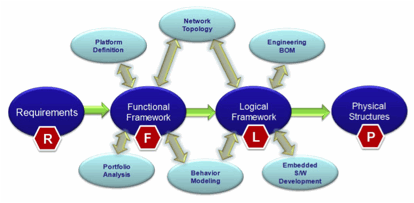
Systems engineering can be evident at any level of the product structure although each product development company may have a unique view of what systems engineering encompasses. The approach requires that some form of functional and logical structure be defined between requirements and the physical components produced to satisfy those requirements. These intermediate structures are what allow designers to simulate and investigate how they will meet the customer’s requirements. The structures produced by this methodology allow them to understand and improve the design.
As each subsystem structure takes form, numerous levels of product and process knowledge can be applied. Dassault Systèmes’ maintains that while, at the lowest level of decomposition, numerical values can be assigned to the models and evaluated, much can also be learned at the higher levels of design information. Relying on experience and qualitative knowledge, automotive design architects can capture system-level interactions and apply lessons learned early in the process that pave the way for easier detailed decisions later in the development process.
Leading the Evolution
Dassault Systèmes continues to offer the means for automotive companies to not only adjust to the pressures in the industry but to excel in delivering products in a highly competitive market. PLM 2.0 and the Version 6 platform combine to provide the necessary tools for resource management due to reduced budgets and skill specialization. The real-time collaborative environment fits smoothly into the changing global business model that continues to emerge. Also, in a targeted response to the need to develop highly sophisticated mechatronics systems, Dassault Systèmes’ suite of tools that support the RFLP approach to systems engineering provides designers the ability to make effective, cross-disciplinary design decisions.
For more information on Dassault Systèmes and their solutions, see www.3ds.com.