In about three weeks members of the software and services providers in the PLM Economy will come together in a series of global meetings known as the PLM Market & Industry Forum.
One of the key topics we will expand on are the trends we see relative to sustainability and PLM. With this in mind we asked Mark Reisig, CIMdata's Sustainability Practice Director to share some of the topics he will be covering in his presentation.
The urgency of addressing sustainability challenges continues to intensify. Rising greenhouse gas (GHG) emissions, global warming, the resulting climate crises, and broader unsustainable practices are driving a transformative shift in the global economy.
Businesses are increasingly embracing sustainability practices, making bold "net-zero" commitments, and responding to the growing demand for carbon-free and environmentally responsible products and services. Product Lifecycle Management (PLM) plays a pivotal role as organizations transition to integrate sustainability throughout the product lifecycle and minimize their environmental impact.
The largest manufactured GHG is carbon dioxide (CO2), which is projected to be 41.6 billion tonnes in 2024, up from 40.6 billion tonnes in 2023. This will cause the average global temperature to reach 1.6°C above pre-industrial levels. Despite commitments under the 2015 Paris Agreement to limit warming to below 2.0°C above pre-industrial levels and pursue efforts to limit the temperature increase to 1.5°C, current trajectories suggest a rise to 2.5°-2.9°C, underscoring the urgency for action.
Many companies are embracing sustainable practices to decarbonize products and services, eliminate waste, and transition from the linear take-make-waste economy to a more circular one. The stakes are high: Global warming threatens ecosystems, accelerates species extinction, impacts food and water security, and disrupts economies. The need for energy will only increase with a population expected to peak at 10.3 billion by the mid-2080s.
The challenge is to profitably provide for our population's basic needs and consumer demands while transitioning to managing products more sustainably with environmental stewardship. This will ensure that future generations inherit a livable planet.PLM is pivotal in achieving sustainability goals, particularly in reducing the Product Carbon Footprint (PCF)—a measure of GHG emissions across a product's lifecycle. About 80% of a product's environmental impact is determined in the design phase. Yet only 24% of companies have visibility into their supply chain during design. This gap highlights PLM's critical role in integrating sustainable practices into product development.
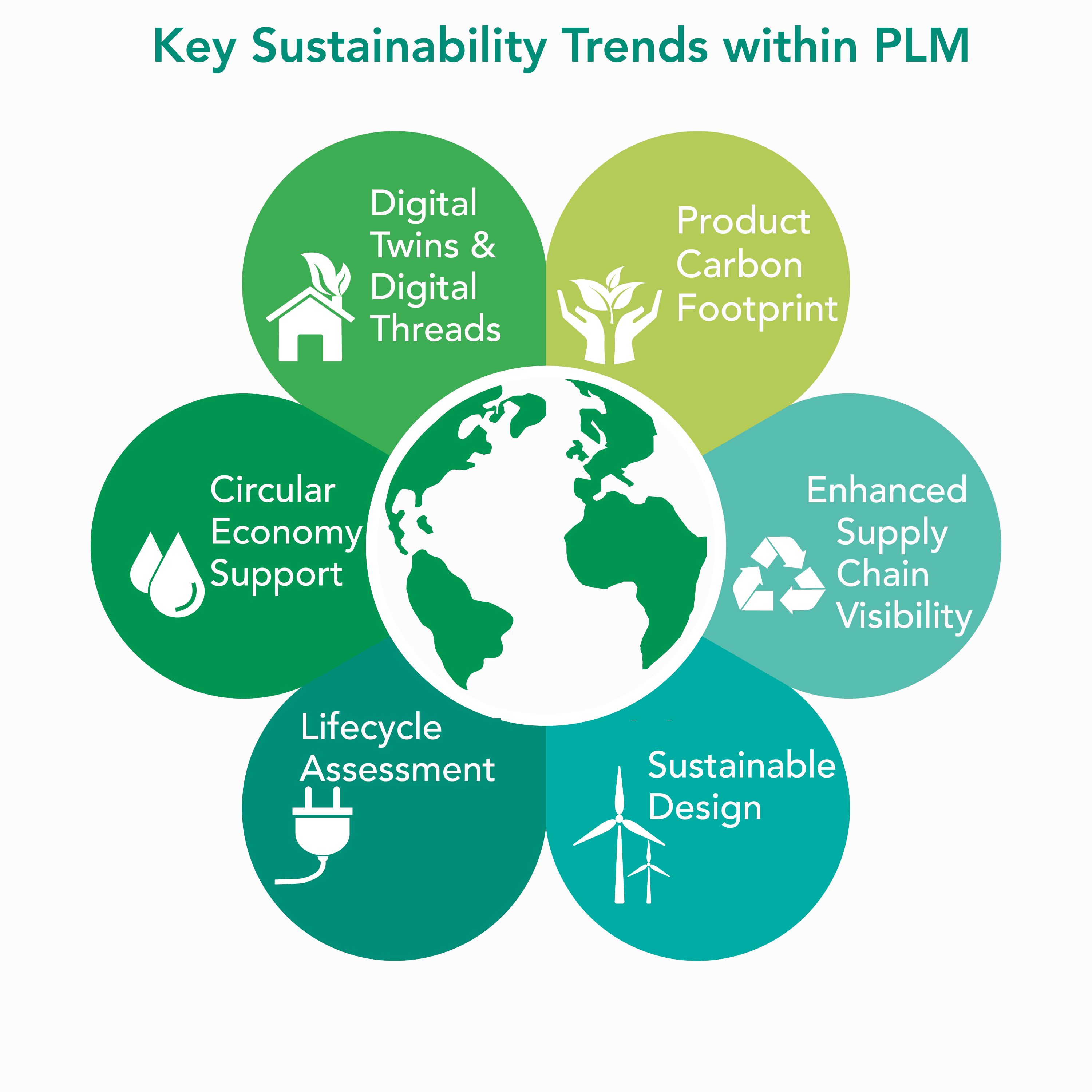
Key Sustainability Trends within PLM:
- Product Carbon Footprint: PLM can reduce the embodied carbon during design, manufacturing, and operations while streamlining costs.
- Enhanced Supply Chain Visibility: PLM provides insights into the embodied carbon of materials and parts, enabling designers to make informed, sustainable choices.
- Sustainable Design: By incorporating modularity, durability, and recyclability, PLM supports eco-friendly product innovations.
- Lifecycle Assessment (LCA): PLM can integrate LCAs to assess and mitigate real-time environmental impacts.
- Circular Economy Support: PLM promotes processes that minimize waste and promote reuse, refurbishment, and recycling, including the European Union’s Corporate Sustainability Reporting Directive (CSRD) requirements for manufacturers to start publishing Digital Product Passports (DPPs), ensuring transparency throughout the product’s lifecycle.
- Digital Threads and Digital Twins: With PLM they optimize resource efficiency and support circular economy initiatives by providing real-time insights into product performance and environmental impact.
Most of the world's largest companies are now reducing their emissions even as the size of their operations and revenues grow. While 65% are cutting emissions, only 37% are cutting scope 3 (value chain) emissions.
Although the number of companies with net-zero targets has grown dramatically, the percentage embedding sustainability into their PLM systems is still in its infancy. The estimates vary on how well companies meet their net-zero targets, but the majority struggle to bridge the gap between their ambition and actions. This reflects a broader challenge: the lack of a consistent, strategic understanding and approach to sustainability and the use of PLM to digitally transform.
Organizational culture and leadership are crucial to aligning sustainability objectives with actionable outcomes. While there is no doubt that most organizations are struggling with their sustainability initiatives, from a PLM perspective, there is far more available to industrial companies in 2025 than just a few years ago. The transition requires collaboration among industrial organizations, software vendors, and systems integrators to embed sustainability into PLM processes. By leveraging advanced capabilities like PCF reduction, supply chain optimization, and digital twins, PLM strategies can help businesses make meaningful progress toward sustainability.
Sustainability is no longer optional; it is quickly becoming a necessity. Embedding sustainability in PLM allows businesses to innovate efficiently while remaining competitive in an evolving carbon-conscious economy. By embracing this transformation, organizations can secure long-term profitability, protect the planet, and contribute to a sustainable future.
The 2025 PLM Market & Industry Forum events take place in Ann Arbor, MI, USA, - March 27, Frankfurt, Germany, - April 10, India - April 14, China - April 18, and Japan - April 21.
Please share your thoughts on this topic in the comments section of this blog!
Or contact me directly at This email address is being protected from spambots. You need JavaScript enabled to view it.
I hope to see you at one of our Forum events!
Mark