 The Solow Paradox is at the heart of the debate about the link between technological investment and business productivity.
In the United States and, for example, in France, spending on information and communication technologies (ICT) has increased from less than 1% of GNP in 1970 to more than 8% of GNP in the USA and more than 5% of GNP in France in 2023, while annual productivity growth in these countries has hovered around 1 to 2% for most years in the period 1970-2023.
Thus, and contrary to popular belief, it has not been formally proven that technological investments have led to productivity gains for companies since the start of these investments.
The Industry of the Future and the Solow Paradox
The Industry of the Future, characterized by automation and robotization, the relocation of production, and the connection of disparate systems, today presents an opportunity to break the Solow Paradox.
Indeed:
- Automation and robotization help reduce production costs and increase productivity.
- Reshoring brings production centers closer to consumer markets, reducing logistics lead times and costs and providing greater flexibility to respond to changes in consumer demand.
- Connecting disparate technologies to platforms facilitates the creation, use, management, and distribution of product-related data, enabling companies to become more agile and efficient: digital continuity, produced by connecting disconnected systems to platforms, streamlines exchanges and automates highly manual tasks, reducing costs and increasing the agility of the whole.
Thanks to platforms, the technologies of the Industry of the Future promise to generate productivity gains that the technologies of the past have not yet been able to deliver.
PLM, a Key System for the Industry of the Future
At the heart of the Industry of the Future is Product Lifecycle Management (PLM).
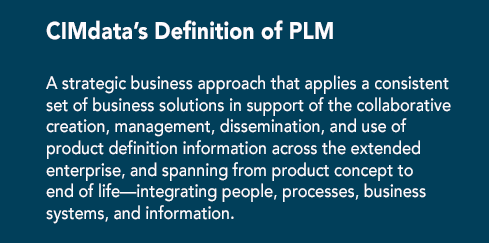 PLM is a strategic business approach that is supported by processes, tools and functions that enable the creation and management in an integrated and coherent manner of all intellectual assets (data and processes) related to a company's products, from their design to through their entire life. By enabling precise and reliable management of intellectual assets related to products, PLM facilitates and makes their design, production, maintenance and end-of-life management more reliable.
By facilitating and making product design and production more reliable, PLM reduces costs, accelerates time to market, and increases business agility. By providing precise and reliable access to product data, PLM improves quality management, maintenance and end-of-life management. Thanks to PLM, companies become more effective because they adapt better to market requirements, and become more efficient because they improve the use of their resources. This is why PLM is considered a strategic business approach since it improves both the effectiveness and efficiency of companies.
Operated by technologies increasingly individually efficient and better and better connected by platforms, the effects of PLM solutions are powerfully amplified. By automating highly manual tasks and streamlining exchanges within PLM approaches, companies see their effectiveness and efficiency increased tenfold by appropriate use of technology. By optimizing the use of company resources on the companies' purpose (its products), the digitalization of PLM approaches has the potential to generate the productivity gains that information technologies have promised but whose invisibility Robert Solow has highlighted.
Thus, if the Solow Paradox has long raised questions about the real value of technological investment, the implementation of the Industry of the Future through PLM solutions offers prospects for resolving this Paradox. By integrating and connecting advanced technologies within end-to-end product lifecycle management approaches, companies can now achieve substantial productivity gains while meeting a growing demand for innovation. In this context, PLM appears to be the fundamental element capable of realizing the vision of the Industry of the Future. And of significantly increasing the productivity of companies.
Please let me know your thoughts on this topic by sharing them in the comments section of this blog!
Or contact me directly at This email address is being protected from spambots. You need JavaScript enabled to view it.
Laurent